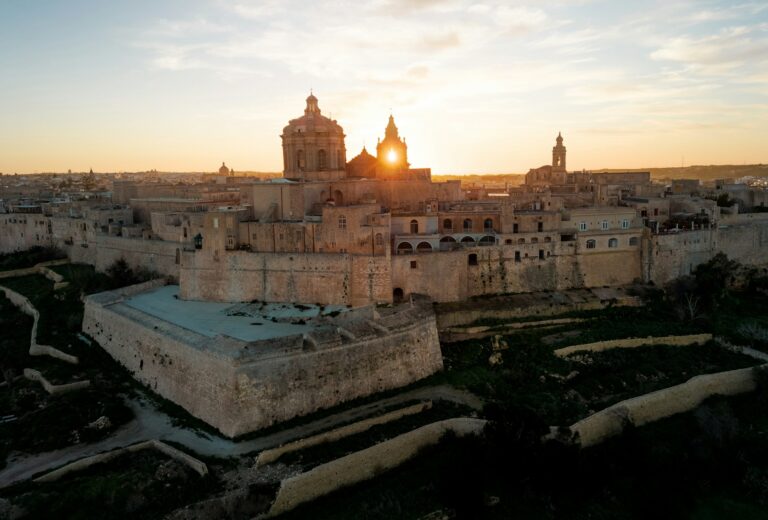

Rome doesn’t give itself up easily — it’s a city that rewards time. But if you don’t have more than a day, exploring Rome in one day still offers a concentrated glimpse of its grandeur.
With only a day, the best approach is to skip the museum queues and treat the streets themselves as an open-air museum.
This guide to Rome in one day is not a checklist. It’s a route that actually makes geographic sense — as long as you’re here to look, not to check every box. A thread that binds the origins of the empire to the refinement of the Baroque.
In practical terms, it involves walking roughly 3 to 4 miles in a linear direction, from south to north. The challenge lies not in the distance itself, but in the time required to truly take in each monument.
The plan is simple: begin at the Colosseum at dawn and end the night in Piazza Navona. The aim is to grasp the scale of the city without paying the toll of endless ticket lines.
Rome in One Day: From the Colosseum to Piazza Navona
The day begins in front of the massive Amphitheatrum Flavium, known to most simply as the Colosseum.
To take in its scale without the crowds getting in the way, it is worth circling around its northern side, ascending toward Via Nicola Salvi. From this vantage point, the structure reveals itself in full, displaying the best-preserved section of its outer arcades.
Descending toward Piazza del Colosseo, your eye is drawn to the Arch of Constantine. Considered the last great monument of imperial Rome, it marks the beginning of the Via dei Fori Imperiali.
This avenue runs in a straight line for nearly two-thirds of a mile and can be walked in about 15 minutes at a steady pace. But there’s so much history along the way that you’ll want to slow down.
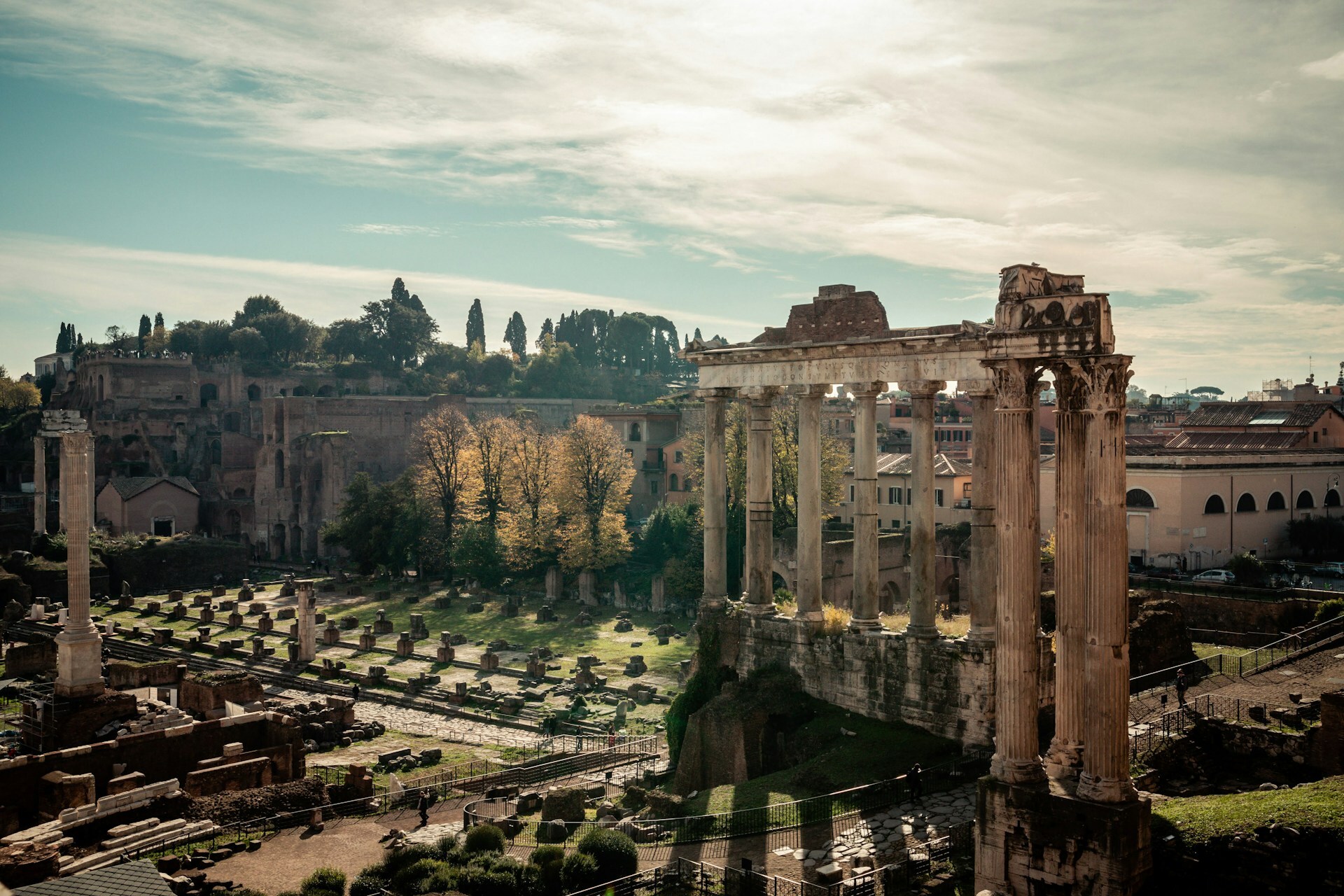
On the right, the Roman Forum lies sunken below street level, where the remains of the Curia and the Temple of Saturn emerge from layers of time. On the left, the Fora of Augustus, Nerva and Trajan narrate, in stone, the city’s expansion.
It is essential to pause before Trajan’s Column, whose spiraling reliefs remain one of the most precise visual chronicles of antiquity. Carved in ascending sequence, the scenes unfold like a continuous narrative, war, strategy, ceremony, etched in marble.
At the very end of the avenue, the imposing Vittoriano in Piazza Venezia serves as a compass. From its free-access terrace, the best panoramic view of the path just traveled opens across the city, a linear journey condensed into a single frame.
From Piazza Venezia, the streets narrow toward the historic center of Rome.
After crossing Via del Corso, a labyrinth of narrow streets begins, gradually leading to the iconic Fontana di Trevi.
Here, the space compresses until the sound of falling water announces the grand Baroque façade. It is best treated as a brief stop, as the crowds often encourage moving on — toward a 10-minute walk that ends in Piazza della Rotonda.
There, the Pantheon of Agrippa dominates the square with imposing solemnity. It remains the best-preserved building of classical antiquity — its architectural and spiritual purpose unbroken for two millennia, first as a pagan temple, later as a basilica.
There is no need to step inside to feel its weight. The scale of its granite columns, viewed from the square, is enough to grasp Roman ambition.
The day concludes in Piazza Navona, just five minutes on foot from the Pantheon. Built over the ancient Stadium of Domitian, its elliptical form preserves the footprint of chariot races.
It is the ideal place to watch the light fade from the ocher façades — closing a circle that began among the ruins of empire and ends in the elegance of the Baroque.
Where to Stay
If you’re in Rome for just a 24-hour stopover, a good hotel is the perfect way to end the day. A few options:
- Hotel dei Barbieri: A 7-minute walk from the Pantheon of Agrippa, it’s ideally situated for those wishing to stay close to Rome’s principal landmarks without sacrificing comfort.
- Donna Camilla Savelli: Located in Trastevere, this former monastery designed by Francesco Borromini offers the quiet of its cloisters and a garden removed from the bustle of modern life.
- Hotel Lunetta: In the heart of the historic center, just about 1,000 feet from Piazza Navona, its spa invites rest after the long walk.