





Seen from space, hundreds of freshwater sinkholes trace a nearly perfect semicircle across the northwest of the Yucatán Peninsula.
Known as the Ring of Cenotes, the formation measures roughly 112 miles across and outlines, with striking precision, the buried rim of the Chicxulub crater. This is where the asteroid that triggered the Cretaceous mass extinction struck 66 million years ago.
Thousands of flooded underground cavities riddle the peninsula. Yet satellite measurements and hydrogeological studies confirm that cenotes cluster densely along a band 3 miles wide.
The geometric center of the arc falls on the coastal town of Chicxulub Puerto, marking the physical imprint of a collision that reshaped the global climate and the course of life on Earth.
How an Asteroid Impact Created the Yucatán Ring of Cenotes
When a rocky body between 6 and 9 miles wide slammed into the shallow waters of what is now the Gulf of Mexico, the energy it released vaporized the Earth’s crust and gouged out an impact basin nearly 125 miles across.
Over the millennia, marine sediments settled over the original crater, burying the depression beneath hundreds of yards of younger rock.
But the shock wave had already done its lasting work, permanently fracturing the deep limestone layers around the edge of the impact.
For millions of years, those structural cracks served as natural channels for groundwater.
Rainwater, made faintly acidic by carbon dioxide absorbed from the air and the forest soil, slowly dissolved the calcium carbonate along the fault line. It hollowed out vast cave networks whose ceilings eventually collapsed, opening the caverns to the surface.
Cenotes in the Maya Worldview: Gateways to Xibalbá and Home of Chaac
In a region where porous ground keeps rivers from forming on the surface, cenotes were the only permanent source of fresh water that allowed Maya cities to flourish. Pre-Hispanic settlements were, in fact, planned around these natural openings, whose name comes from the Maya word dzonot, meaning “abyss” or “cavity with water.”
To the ancient people of the Yucatán, these flooded vaults were far more than reservoirs. In the Maya worldview, cenotes were thresholds to Xibalbá, the underworld inhabited by the deities of death and regeneration. They were also the dwelling place of Chaac, god of rain and lightning.
Underwater archaeological research has documented that these caverns served as ritual sites of the highest order.
During ceremonies meant to secure the harvest or ease drought, priests cast jade, ceremonial vessels, copal, gold and human remains into their depths. The still water below ground was understood as a mirror: a direct line of communication with the sacred realm.
The Most Iconic Cenotes of Yucatán
The geological evolution of the Yucatán’s subsoil shaped each cavity differently depending on its age, producing fully open cenotes, semi-open ones with partial vaults and enclosed caverns lit by narrow natural skylights.
Among the peninsula’s best-known cenotes:
- Cuzamá and Homún Cenotes: Set directly on the arc of the Ring of Cenotes southeast of Mérida, these two areas hold dozens of cavities linked by underground rivers. Sites such as Chelentún, Chakzinikché and Santa Bárbara reveal the successive stages of karst collapse along the fault of the Chicxulub crater.
- Sacred Cenote of Chichén Itzá: Measuring 200 feet across, with sheer walls that drop 89 feet to the water’s surface, it was the foremost pilgrimage site of the Postclassic Maya world. Archaeological dredging in the early 20th century extracted thousands of ritual objects from its muddy floor.
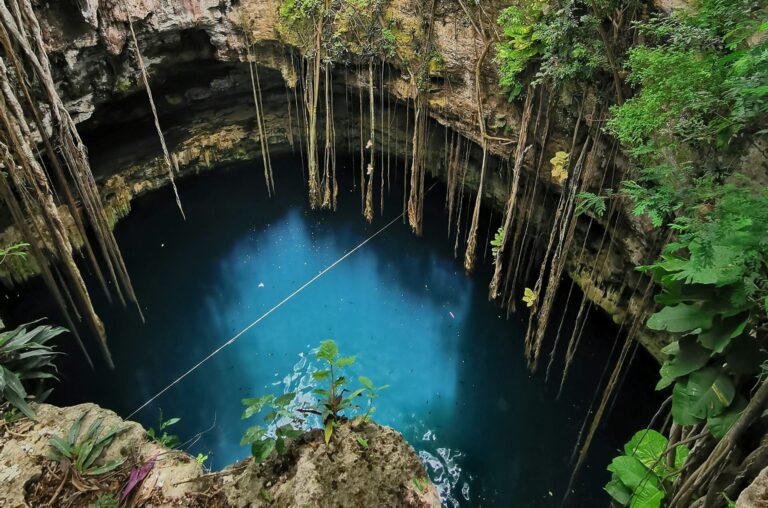
- Ik Kil Cenote: Located 2 miles from Chichén Itzá, this open cenote holds its water 85 feet below ground level. Through its circular mouth, the hanging roots of jungle trees reach down to crystal-clear water 130 feet deep.
- Suytun Cenote: Near Valladolid, this enclosed cavern features a stone platform that reaches toward the center of its pool. At midday, a single opening in the limestone ceiling sends a vertical shaft of light onto the water, illuminating the stalactites hanging from the vault.
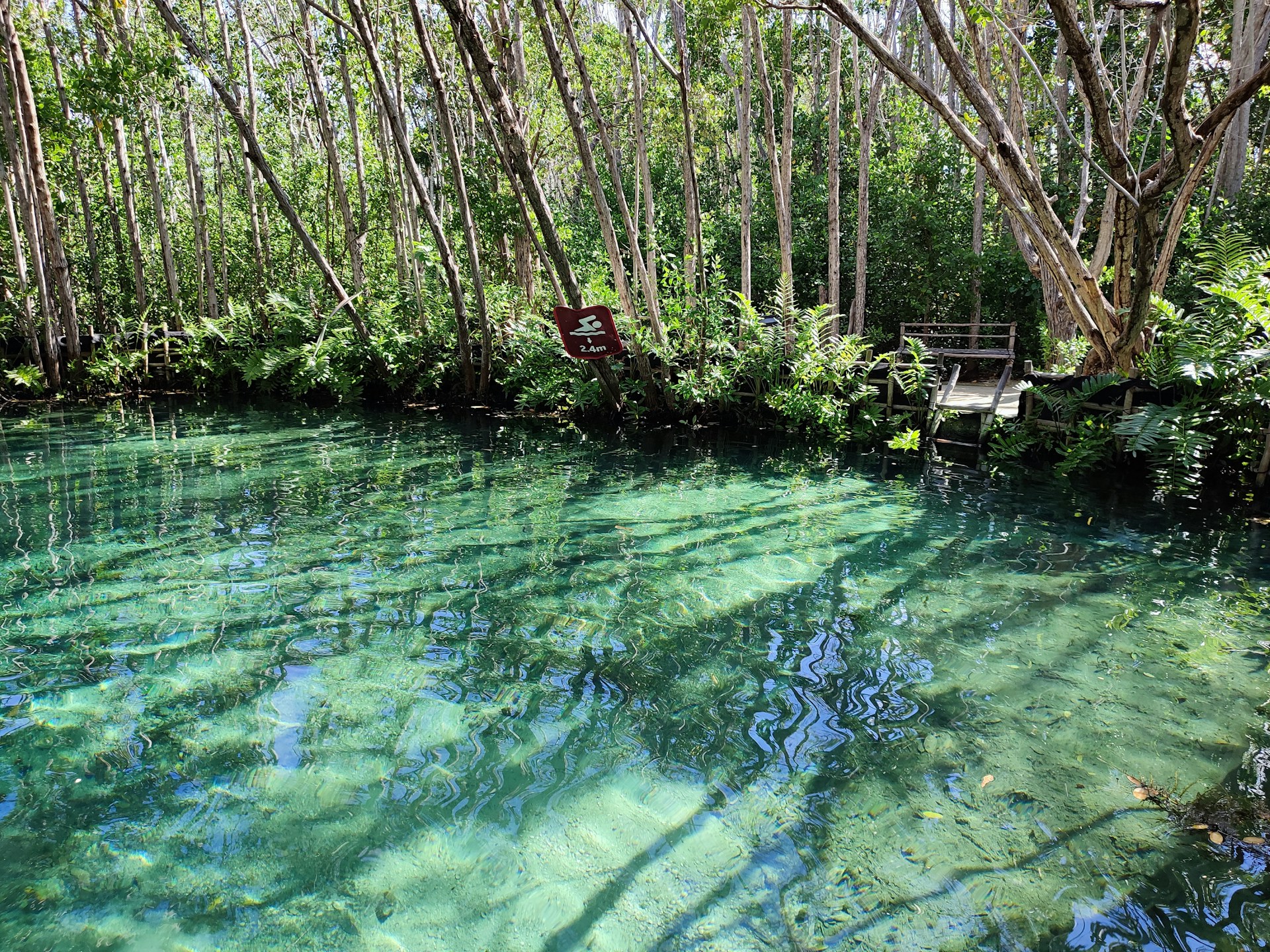
- Xkekén and Samulá Cenotes (Dzitnup): A few miles from Valladolid, these two neighboring underground caverns are known for their intense turquoise water and mineral formations thousands of years in the making. In Samulá, the roots of an álamo tree pierce the rock ceiling and plunge into the pool below.
The Fragility of an Aquifer Open to the Surface
The same porous limestone that gave rise to the arc of cenotes also leaves the system vulnerable to human activity.
With no impermeable layers of soil to filter waste from above, urban sewage, agricultural fertilizers and runoff from the industrial farms spreading across central Yucatán seep quickly into the underground currents.
In 2013, the state government established the Ring of Cenotes State Geohydrological Reserve, a protected area of more than 541,000 acres spread across 13 municipalities. It now appears on UNESCO’s World Heritage Tentative List.
In its clear water and limestone walls, this natural corridor still traces, at the surface, the exact outline of the cosmic collision that ended the age of the dinosaurs.