

Auko Eco-Wellness Lodges opened in July 2026 on the banks of the Son River, at the edge of Phong Nha-Ke Bang National Park in central Vietnam.
The property offers something fundamentally different from the usual wellness-retreat formula. Rather than insulating guests from their surroundings, it builds the entire experience around a karst landscape that began forming more than 400 million years ago, making it one of the oldest in Asia.
What Building an Eco-Wellness Lodge Really Involves
Phong Nha-Ke Bang has been designated a UNESCO World Heritage Site twice. First in 2003, for its geological and geomorphological significance, and again in 2015, for the exceptional biodiversity found within its cave and forest systems.
The park contains the oldest karst in Southeast Asia, with more than 740,000 acres of limestone mountains threaded by underground rivers.
Deep within that territory lies Son Doong, the largest cave in the world by volume. A local hunter discovered it in 1990, though it wasn’t officially explored until 2009. Its passages are large enough to fit entire city blocks of skyscrapers, and natural skylights let sunlight fall onto jungles growing inside the cave itself.
Auko does not offer direct access to Son Doong — expeditions there are strictly limited and require separate reservations — but it serves as a gateway to that same karst region and to much of its more than 137 miles of caves and underground rivers.
Built to Tread Lightly
The property comprises 30 tent-style cabins connected by elevated bamboo walkways above the jungle floor. Construction relied on recycled boat timber, bamboo, and locally sourced materials. Each cabin has an outdoor bathtub and a private terrace.
The aesthetic deliberately avoids the familiar signals of hotel luxury. There is no marble, no sweeping glass — just a commitment to minimizing the building’s footprint on the surrounding environment.
That commitment is backed by EDGE Advanced certification, a sustainable construction standard developed by the International Finance Corporation (IFC), a member of the World Bank Group.
This is more than a marketing claim: EDGE Advanced requires independent technical audits demonstrating savings of at least 40% in energy and water consumption compared to a comparable conventional building in the same region, along with significant reductions in the embodied energy of construction materials.
A Wellness Program Rooted in Cham Tradition
At the heart of the property is Lumina Wellbeing, the wellness space where the daily program — included with every stay — takes place.
Its rituals draw from the traditional healing practices of the Cham people. This civilization, which flourished across central and southern Vietnam for centuries, is known for its brick temples, its Hindu-Buddhist cosmology, and its deep knowledge of local medicinal plants.
The signature experience, called the Nature Hydro Journey, runs 60 minutes and unfolds in three stages: a steam bath using mineral-rich Rhassoul clay blended with native plants, an open-air shower set within the vegetation, and a final plunge into a cold-water pool between 50 and 59 degrees Fahrenheit, with views of the karst cliffs.
Each guest also receives a wild-herb foot bath and a 30-minute reflexology session in their own cabin.
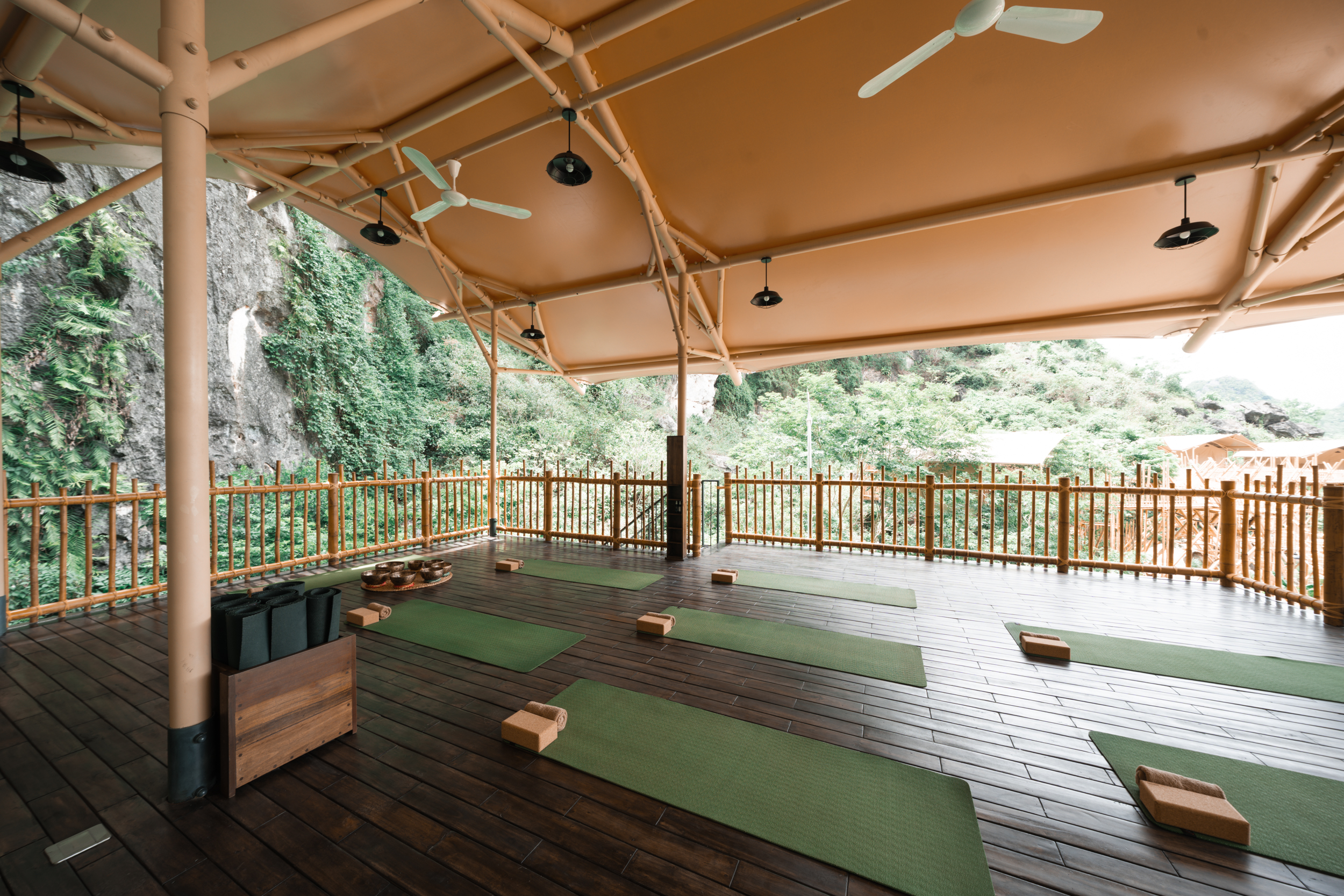
The program extends further still, with outdoor yoga in an elevated studio, forest meditation, and sound baths inside a natural cave, where gongs and Tibetan singing bowls resonate against walls of limestone.
Three Ways to Experience a Stay
Auko builds its program around three itineraries that guests can mix and match depending on how they feel each day.
Still Way prioritizes rest and introspection. Wild Way is built for guests after physical adventure — hiking, climbing, and cave exploration. Open Way sits between the two, with no fixed schedule, letting guests move freely between stillness and activity as the mood strikes.
Still Way prioritizes rest and introspection. Wild Way is built for guests seeking physical adventure — hiking, climbing, and cave exploration. Open Way sits between the two, with no fixed schedule, letting guests move freely between stillness and activity as the mood strikes them.
That flexibility also makes Auko well-suited to hosting independent retreats. Yoga instructors, wellness facilitators, and creative groups can build their own programs around the lodge’s existing facilities, without having to arrange the logistics from scratch.
From the Jungle to the Table, and the Textiles of the Co Tu People
The property’s restaurant, called Origin, follows a farm-to-table philosophy rooted in the immediate region.
River fish, native herbs, and local produce shape a menu that shifts with the seasons. Fireside dinners and jungle picnics round out the offering.
The interiors also incorporate hand-woven textiles made by the Co Tu people, an indigenous community from the central highlands of Vietnam known for weaving traditions passed down through generations and for a close-knit, village-based way of life.
Getting There
The most direct route is by air to Dong Hoi Airport, with flights available from Ho Chi Minh City or Hanoi, followed by a one-hour private transfer to the property.
Alternatives include flying into Hue and making a three-hour transfer, arriving by train at Dong Hoi station from Da Nang, Hue, or Hanoi, or driving five hours from Da Nang.
Those who prefer a more adventurous arrival can travel by motorcycle from Hanoi, with a stop in Vinh or at Cua Lo beach along the way.
However you arrive, getting to Auko means passing through the same landscape the property is built to celebrate: hours of road through limestone mountains, rivers that vanish underground, and a jungle that has been quietly reorganizing itself for millions of years.
Perhaps that is fitting for a place whose whole purpose is to guide guests deeper in, rather than away.
Rather than a place to disconnect from the world, Auko offers something closer to the reverse: it lets the landscape — its geology, its history, its communities — become the real treatment, if only for a few days, much like exploring the mysterious underground depths of La Salamanca.



