
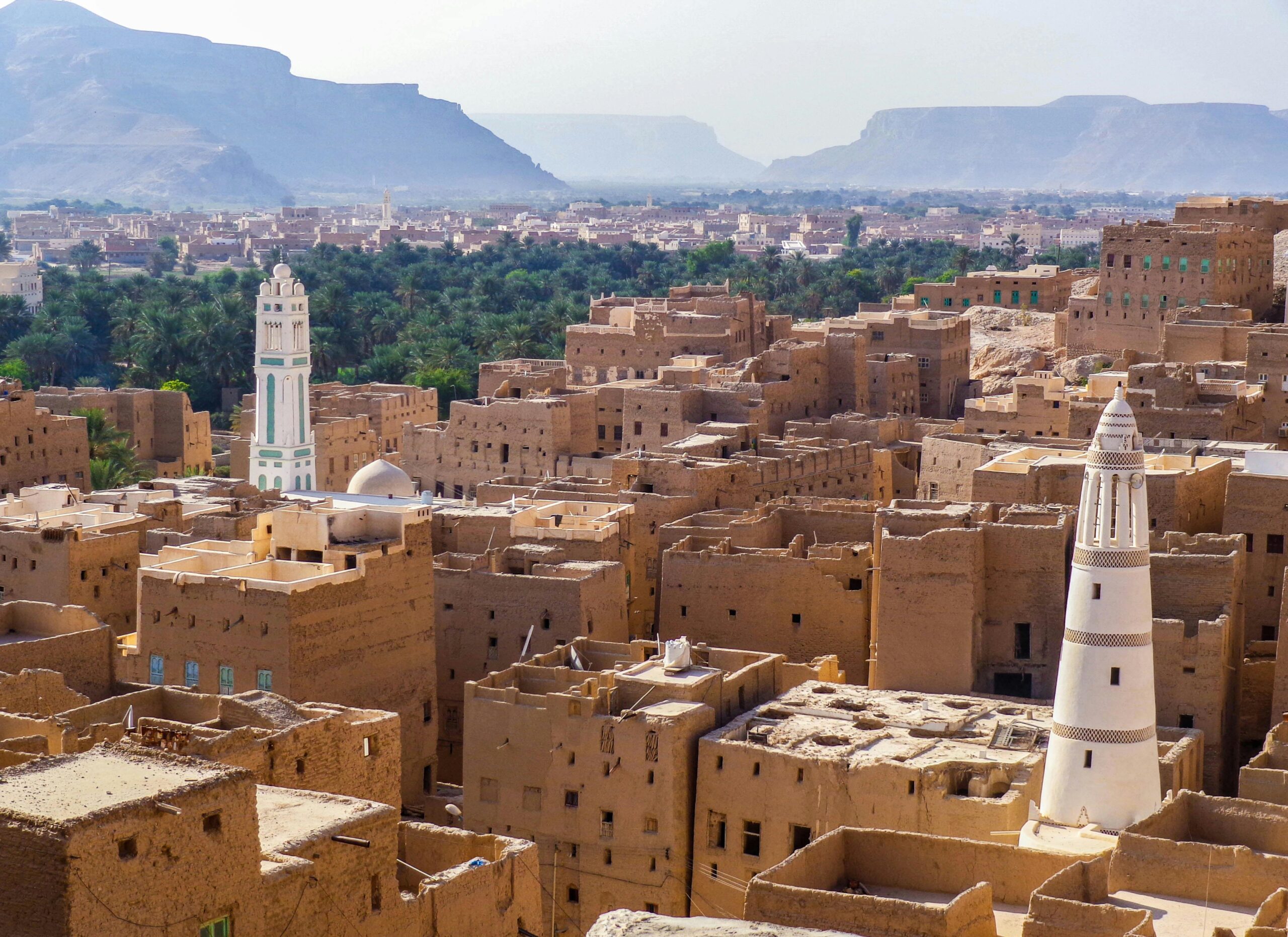
Rising from the heart of the Wadi Hadramaut valley, Shibam, in Yemen, is one of the most astonishing cities on earth. Better known as the “Manhattan of the Desert,” it stands as the first recorded example of vertical urban planning in human history.
This adobe mirage defies every architectural instinct and remains one of the most remarkable expressions of the human capacity to adapt to some of the world’s most hostile environments.
It is not the palm trees or the dunes that interrupt the flatness of the landscape. It is a skyline of ochre blocks rising toward the sky, tower after tower, as though someone had dropped a medieval Manhattan into the sand.
But it is not the height that makes Shibam exceptional — it is the apparent fragility. These towers bear no resemblance to the steel-and-glass structures of the modern world. They are built from a mixture of mud, straw, and timber, bound together with water, and they rise as high as eight stories.
This is the story of those mud giants — and how, century after century, they continue to defy both gravity and erosion in one of the most remote and remarkable corners of the earth.
Genesis of a Walled City: The Origins of Shibam’s Verticality
The existence of Shibam is, at its core, an act of resistance.
Founded roughly 2,500 years ago, the city visible today is the result of a massive reconstruction in the 16th century, following a devastating flood that destroyed the valley’s earlier settlements.
But why build upward in a desert that seems to stretch forever? The answer lies in two critical factors: security and geography.
Bedouin raids and attacks from rival tribes were a constant threat. Elevating the homes and encircling the city with a defensive wall transformed Shibam into an impregnable fortress.
At the same time, there was simply no room to safely expand outward. The threat of floodwaters made horizontal growth too dangerous. Instead, Shibam was built on a slightly raised mound that shields it from flooding while keeping it close to its primary water source.
In short, the people of Shibam had no choice but to build toward the clouds.
From that necessity grew a singular urban fabric: nearly 500 adobe towers packed tightly together, enclosed by a wall that still marks the precise boundary between this mud civilization and the emptiness of the desert beyond.
Architecture of Survival: The Miracle of Mud
The secret of Shibam‘s survival lies in a perfect marriage of its building material and the ongoing care of its people.
The city’s skyscrapers are built entirely from sun-dried adobe bricks. But the design is far from arbitrary — it follows a precise logic of survival and thermal comfort.
The ground floors, with almost no windows and extraordinarily thick walls, are used to store grain and livestock, protecting them from ground moisture and the scorching desert heat.
The middle floors are where social life unfolds. These are the levels of the reception rooms and the men’s quarters, with small, strategically placed windows that allow air to circulate and cool the interior naturally.
The upper floors are reserved for women, children, and sleeping quarters. Being the highest, they benefit from the most ventilation and light.
In earlier times, they also served as watchtowers. From the safety of those heights, families could scan the horizon for approaching threats.
At the very top, the roof terraces offer refuge on warm summer nights; at that height, the air brings a welcome drop in temperature.
Today, the greatest enemy of Shibam is erosion. Rain and wind wear down the adobe constantly. To counter this, residents practice a vital tradition: at regular intervals, they replaster the walls and rooftops with a layer of lime plaster known as mahdar.
This coating does more than waterproof the structure. It reflects the intense sunlight, keeping the buildings cool and giving the city its characteristic pale, whitewashed appearance.
Freya Stark and the “Manhattan of the Desert”
Shibam‘s famous nickname was not dreamed up by a tourism board. It was coined by one of the 20th century’s most intrepid explorers: Freya Stark.
In the 1930s, when Yemen was all but inaccessible to Western travelers, Stark made her way into the Hadramaut valley and was transfixed by Shibam’s silhouette rising from the sand.
She was the one who christened it the “Manhattan of the Desert” in her travel chronicles. For Stark, those adobe towers rising from the desert floor called to mind the skyline of New York, which was only just beginning to take shape.
Through her writing, the world discovered that in a remote corner of the Arabian Peninsula, a mud metropolis had long been practicing the very principles of dense communal living and vertical architecture that the West was only beginning to explore.
The Challenges Facing Shibam Today
Unlike many of Yemen’s historic sites, the streets of Shibam are not empty. Some 7,000 people still walk them.
Families continue to live in their adobe towers, and the traditional vertical social structure remains largely intact — though with certain modern additions: electricity, some plumbing, and satellite dishes on the rooftops.
The maintenance ritual is not a relic of the past. It is an ongoing reality. If residents were to stop applying those layers of mud every few years, the houses would collapse under the combined assault of wind and rain. In this sense, the survival of Shibam depends, in no small part, on the commitment of its community.
Extreme weather is another pressure. Torrential rains, growing more erratic with climate change, strike the structures with increasing force.
Yemen’s civil war has further cut off international restoration funding — a crisis that led UNESCO to place Shibam on its List of World Heritage in Danger.
This city of adobe is a virtually unique example of a 500-year-old structure still fulfilling its original purpose in the 21st century — a living monument to human resilience.
Shibam literally breathes through its mud walls, and it fights to keep from dissolving back into the desert dust from which it came.