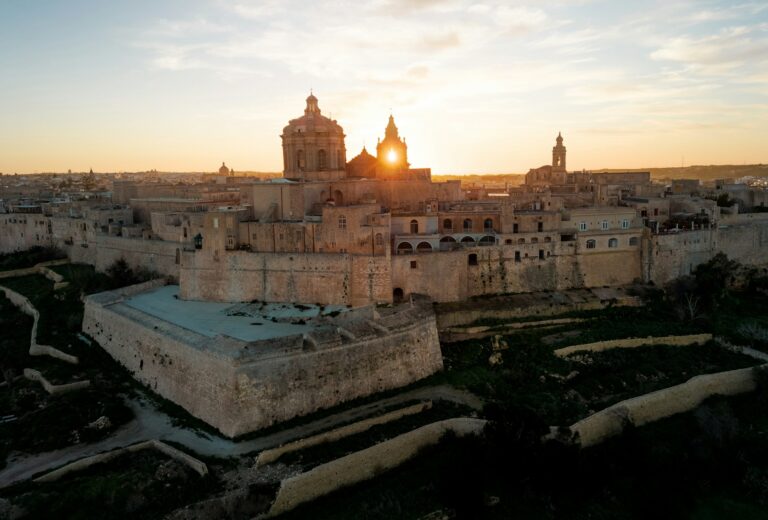

The African continent is full of fascinating stories, and today we’re heading to southern Africa to uncover one of the most mysterious. We’re going to Namibia, a country in southwestern Africa that borders South Africa, Botswana, and Angola. It is also the driest country in sub-Saharan Africa.
Namibia is home to the world’s oldest desert, the Namib, where you’ll find the tallest dunes on Earth, some towering over 300 meters.
This is a land where wildlife still thrives, boasting the largest population of wild cheetahs and desert-adapted elephants that have learned to survive in some of the harshest conditions on Earth.
So vast is this desert that it has buried an entire town. That’s the story of Kolmanskop, a ghost town swallowed by sand over the past century—now partially restored to tell a story that must not be forgotten.
From Diamond Rush to Deserted Ruins
It all began in the late 19th century. Western nations were busy “discovering” Africa’s breathtaking landscapes—until exploration gave way to exploitation.
In 1884, during the Berlin Conference, Europe’s colonial powers carved up the continent with no regard for the people who lived there. Namibia was claimed by Germany and renamed German South West Africa.
The Germans began building a railway line across the territory. It was during this expansion that a worker stumbled upon some unusual stones. He brought them to his supervisor, who quickly realized they were diamonds. And so began the rise of Kolmanskop.
Just four years earlier, local tribes had risen up against colonization, a rebellion that ended in tragedy. More than 60,000 Herero people, an indigenous group in the region, were killed by German forces.
By 1908, the area had become a boomtown. Hundreds of colonists settled there, drawn by the promise of diamond riches. Meanwhile, indigenous workers lived in barracks, exploited in the mines while German settlers grew rich off their labor.
Kolmanskop became a strange oasis of luxury in the middle of the desert. The town grew quickly, boasting a casino, a hospital, a school, and—ironically—an ice factory.
But what rose fast fell even faster. Just thirty years later, richer diamond fields were found further south. Kolmanskop’s mines were depleted, and the colonists moved on in search of richer deposits. By 1956, the last resident had left Kolmanskop, and the town was abandoned.
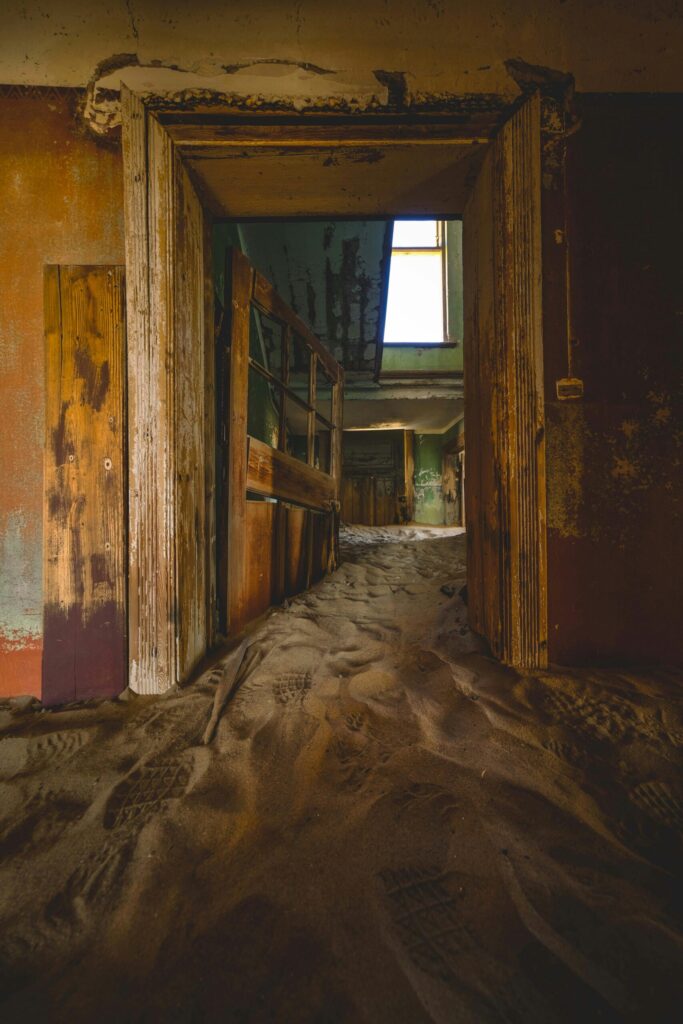
The sand began to fill the rooms.
Furniture was buried beneath it.
The memories of a short-lived city were lost to time.
Buried in Sand, Resurrected by Tourism
It wasn’t until 1980 that a local mining company restored some of the buildings and opened a museum to preserve Kolmanskop’s history. Other tourism companies followed, preserving more structures over time.
Today, tourists and photographers flock here, enchanted by the idea of walking through rooms filled with sand, hoping to find a hidden relic amid the eerie beauty of a ghost town.
Kolmanskop stands as a testament to two sides of human history: the extraordinary ability to carve out a thriving city in the middle of nowhere… and the violence and greed that so often lie behind such places, and ultimately lead to their ruin.
Our history is full of contradictions.