Epecuén was once a natural spa that promised healing.
The Indigenous people of the area revered Lake Epecuén for its healing properties.
In the early 1920s, Villa Epecuén was founded on the shores of a salty lagoon, so salty that it approached the levels of the Dead Sea, with thermal waters that were said (later confirmed by science) to have healing properties.
The village expanded quickly: hotels, guesthouses, shops, nightclubs, restaurants, luxury homes, salt-export industries, bus services, and three railway lines connecting it to Buenos Aires and surrounding towns. Then came the school and the church.
Lake Epecuén offered a promising future for the village and its residents.
It attracted local and European tourists alike. Its hypersaline waters attracted those seeking relief for respiratory, skin, and even emotional ailments.
For decades, Epecuén was a destination for rest and healing, with a vibrant social life. Surviving postcards show tree-lined streets, vintage cars, and families bathing on the shore.
No one imagined that the very water that gave it life could sweep it all away.
A Catastrophe
In 1985, after heavy rain and a series of failed decisions on the structural improvement of water resources, water levels began to rise.
First, it covered the lowest streets. Then, the houses. And finally, the whole village. People had to flee as soon as they could. What they could not take with them was swallowed by the water. It took two years for the water to reach its peak.
Only one inhabitant refused to leave: Pablo Novak, who went on living among the ruins rather than be relocated with the rest of his neighbors.
Epecuén remained submerged for more than 25 years. The salt did its silent work: it devoured the wood, eroded the walls, and whitened everything it touched. What remains looks like a mold cast in time. For those who lived there, it was as if time had stopped, as if the ground had swallowed the history of an entire village.
In 2024, after a long life spent staying in his home and walking through the ruins with his dog Chozno and his bicycle, Pablo Novak passed away, and Villa Epecuén was officially declared a deserted village.
A Ghostly Return
In recent years, as the lagoon’s level has dropped, Epecuén has begun to emerge once again.
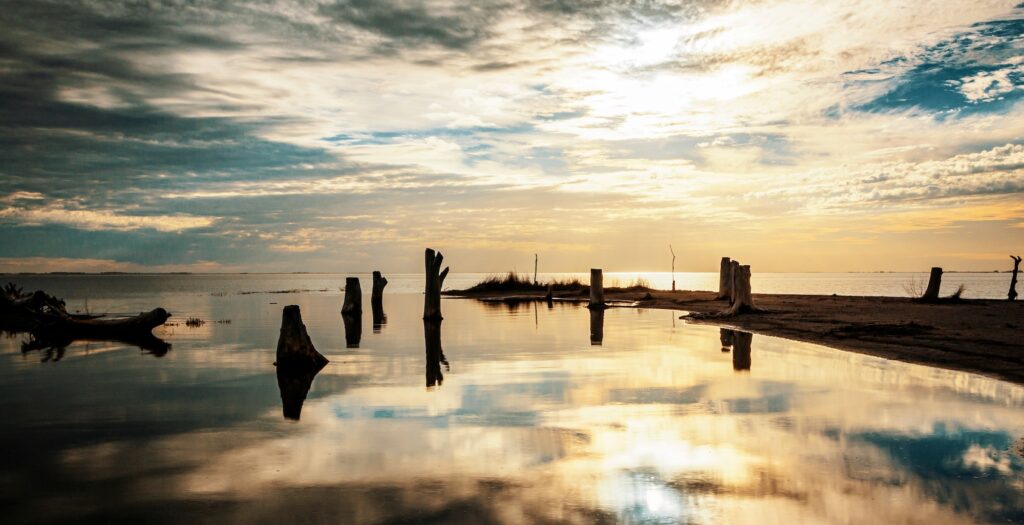
What you see today is not a village: it is its skeleton. Bare columns, dead trees, ruins of hotels with bathtubs still in place, crumbling buildings, rusted cars. Everything shines with a white patina.
Walking through Epecuén is a strange experience: the total silence, the crunching of a salty ground, the ghostly sound of the wind. There are signs of what once was, but it feels like a faded postcard from another era.
Like a Pompeii without lava, or an Atlantis that only half-emerged.
Tourism, memory, and wonder
Today, you can visit Epecuén from Carhué, a nearby town offering accommodation and thermal activities. Some people come out of curiosity, others are drawn by the history, and others come to take artistic photos or document the site.
The site has been used by musicians, filmmakers, and photographers seeking to capture that blend of beauty and desolation.
Among other significant events, in 2017, a horror film called The Forgotten was shot there, and in 2021, under mandatory isolation measures due to the pandemic, the emblematic band Indio Solari and Los Fundamentalistas del Aire Acondicionado gave a live concert that was broadcast, despite being intended as a paid show for subscribers. Due to technical issues, it was released in real time over the internet. Myth upon myth, each one spawning the next.
Some call it a ghost town, but it’s not just that: it is also a place that invites reflection on the passage of time, the relationship between humanity and nature, and the fragility of what is built.
The Salt Doesn’t Forget
Today, Epecuén is a unique destination: it has no colonial ruins or ancient castles, yet its aesthetic is unforgettable. A modern village ravaged by nature, preserved among white tones and silence.
People visit Epecuén to float in the lake’s waters, admire the flamingos visible in the distance, relax in the thermal waters, explore the village, and inhabit its beaches.
You can visit The Christ, by architect Francisco Salomone, and also the salt-bleached forest, its dead trees standing forever white, roots exposed.
You can see the slaughterhouse from the outside; it was also designed by Francisco Salomone, but it is not possible to enter. You can also visit the ruins of the Princess’s Castle.
Past the ruins, at the old railway station, is the Interpretation Center, a place recommended to visit before visiting the town because it provides the context you need to understand what you’re about to explore. It serves as a museum, preserving objects and interesting data for visitors.
In some nearby hotels, there are even saline pools.
In winter, you can see the salt of the lake on the shores and sunsets that, even in this uninhabited landscape, feel like a promise of life to all who witness them.