
Barcelona’s skyline changed forever in early 2026 when the upper arm of the cross atop the Tower of Jesus Christ was finally set in place.
This architectural milestone brings the basilica to a height of 565 feet, making it the tallest church in the world and overtaking the Ulm Minster in Germany.
It is also the most significant milestone yet in a project Gaudí set in motion in 1882.
As with every element of the temple, nothing here is left to chance — including the year. 2026 marks the centenary of Antoni Gaudí’s death. The completion of all six central towers is, perhaps, the most fitting tribute to the man who defined and revolutionized Catalan modernisme.
But those hoping to see the basilica fully finished will need to wait a little longer — roughly another decade before the Sagrada Familia is complete.
The Six Central Towers Are Now Complete
With the Tower of Jesus Christ complete, the full group of six central crossing towers that Gaudí designed for the basilica is now finished.
The ensemble includes the Tower of the Virgin Mary — with its distinctive twelve-pointed star, unveiled in 2021 — and the four Evangelist towers, completed between 2022 and 2023. All connect to the Tower of Jesus Christ — the Virgin Mary Tower — via the interior, and to the four Evangelist Towers via a series of bridges. Four additional towers, planned for the Glory Facade, remain to be built.
Their arrangement, too, reflects Gaudí’s vision: a forest of stone rising toward the sky, where architecture and faith are one.
Building the Tower of Jesus Christ
The cross crowning the tower is a feat of engineering in its own right — 56 feet tall, with arms spanning 44 feet. It is clad in white ceramic and glass, materials chosen to catch and reflect sunlight by day and glow under floodlights at night.
The structure is accessible from the inside and has been engineered to withstand wind gusts and harsh weather at that altitude. Its four arms will project powerful beams of light visible from across the city.
The tower itself was built using the prestressed stone technique, a method that allows stone and steel panels to be assembled off-site and fitted into place with precision — saving years of laborious work at elevation.
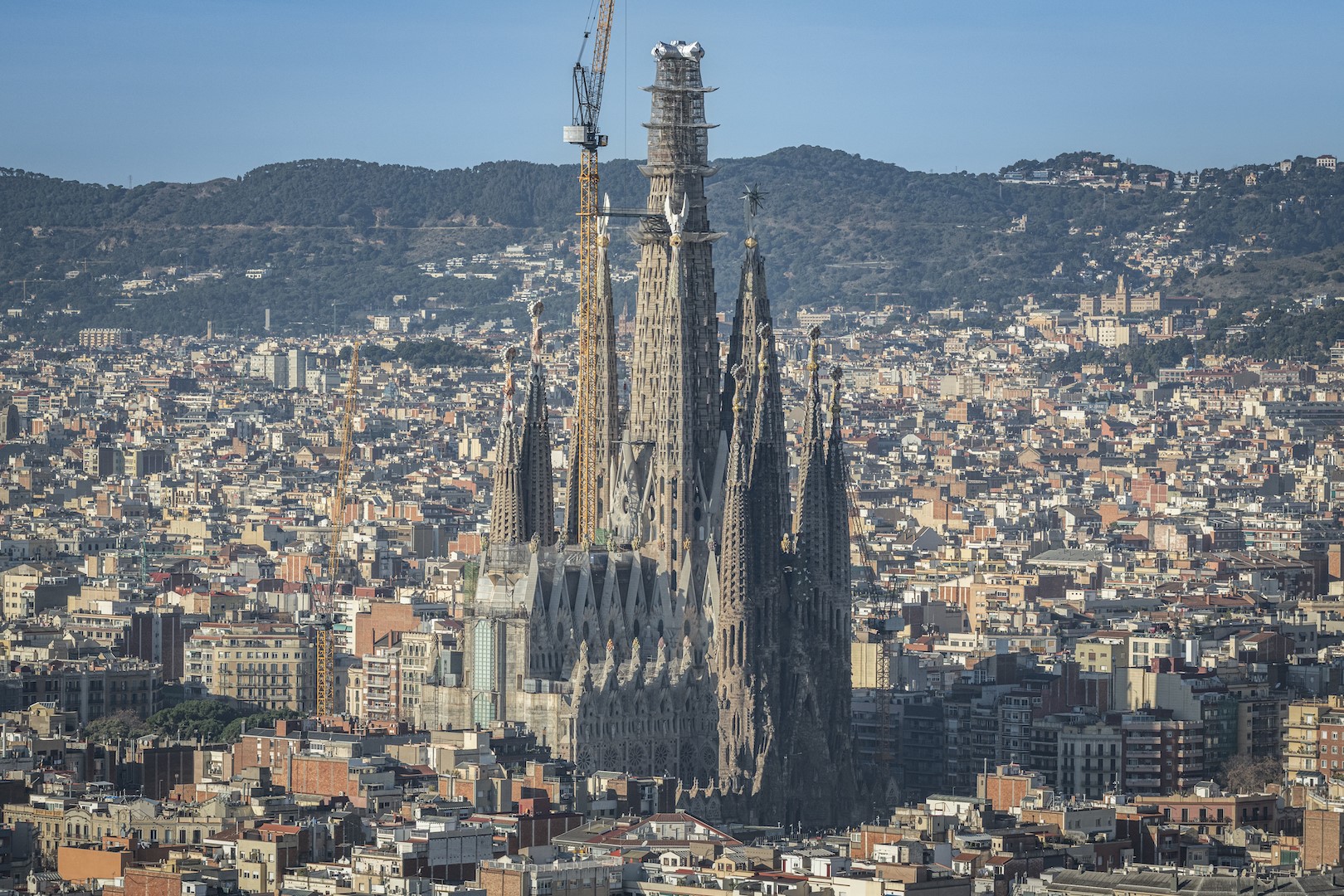
With the cross in place, the Tower of Jesus Christ stands at exactly 565 feet. That number was no accident. The choice was deliberate: the temple had to be imposing, yet stop short of surpassing Montjuïc.
For Gaudí, human creation was never meant to surpass nature. At 568 feet, Montjuïc remains the city’s highest point, preserving the symbolic hierarchy Gaudí built into his original plans.
The official inauguration is scheduled for June, the anniversary of Gaudí’s death — the result of a tram accident on Barcelona’s Gran Via.
In the months ahead, workers will turn to the tower’s interior core, where a sculpture of the Agnus Dei will be installed alongside a lighting system designed to project beams of light from the cross across the city.
The Glory Facade Dispute and the Road to 2034
With this phase complete, Barcelona closes the chapter on height and enters the final stage of ornamentation and visitor access. Attention now shifts to the Glory Facade, on Carrer de Mallorca, which will serve as the basilica’s main entrance.
It is the most complex remaining section of the basilica. The design calls for a monumental staircase that would require demolishing the residential buildings currently standing in front of the entrance. As of today, that urban planning dispute remains unresolved.
If all goes well, it will not be until 2034 that this project — which has shaped Barcelona’s identity for more than 140 years — is finally complete.