





If you have a pair of wireless earbuds nearby, take a look at them for a moment. Chances are they carry a small blue symbol that looks like an angular scribble.
That scribble is a monogram made from two runes, H and B, the initials of Harald Blåtand, or Harald “Bluetooth,” the 10th-century Danish king who lent his name to Bluetooth technology. Without knowing it, you are carrying a fragment of Viking writing.
Now for the real story, which is considerably better.
Runic Writing Explained: An Alphabet That Doesn’t Start With A
Runes are the characters that several Germanic peoples used for writing for centuries. Together they are known as the futhark, a name with a thoroughly practical origin: it spells out the first six letters in the traditional order, f, u, þ, a, r and k. The word “alphabet” works the same way, built from alpha and beta.
The oldest version, the Elder Futhark, had 24 runes. The earliest inscriptions known with certainty date to around A.D. 150.
One of the most famous appears on a comb found in Vimose, on the Danish island of Funen, dated to around 160. It is very short and reads harja. Another piece, the Hole stone in Norway, may be older still: it has been placed between 50 B.C. and A.D. 275, though the range is wide.
The key to understanding the system is the Kylver stone, a grave slab found in 1903 on Gotland, Sweden. Dating to about 400, it carries the complete sequence of all 24 runes, in order. It is, essentially, the alphabet of its day, fixed in stone.
The Great Cut: From 24 Runes to 16
During the seventh and eighth centuries, something curious happened. The language of Scandinavia changed, and instead of expanding to keep pace, the alphabet shrank. By the end of the eighth century the reduction was complete: only 16 of the 24 runes remained. This was the Younger Futhark, the script of the Vikings.
It came with an awkward consequence. With fewer signs than sounds, a single rune had to stand for several similar sounds, and readers had to work out from context which word was meant. That is part of the reason specialists still debate how to interpret some inscriptions.
Nor was the Younger Futhark written the same way everywhere. There was a long-branch version, sometimes called Danish, and a short-twig version associated with Sweden and Norway. There was even a variant whose runes had no vertical staves at all.
Why Are So Many Viking Runes Carved in Stone?
Although runes were written on wood, bone, metal and other materials, we tend to picture them carved in rock. There is a reason for that: stone endures. Wood rots and bone breaks. The monuments raised to last are the ones that have come down to us.
Some 3,000 Viking Age rune stones survive, the vast majority in Sweden, above all in the Uppland region. Nearly all are memorials, commissioned by individuals to honor relatives who had died.
At times the message feels startlingly intimate. On the Gripsholm stone, for example, a mother named Tola remembers her son Harald, brother of Ingvar, who died on an expedition to distant lands in the east.
There was a political dimension, too. Raising a stone of this size was a way to display wealth, lineage and power.
A rune stone seen today looks gray and austere. In its time, it was nothing of the kind. The stones were often painted in vivid colors, applied to the runes and figures alike, and the result looked more like a poster than a gravestone.
Modern replicas painted in reconstructed colors reveal how dramatic the difference is. Over the centuries, wind and rain stripped the paint away and left only the carving.
The stones were cut by skilled craftsmen known as rune masters, who worked with chisels. And as in any trade, they sometimes made mistakes. Some of those slips are still visible in the stone.
The Stones That Say the Most
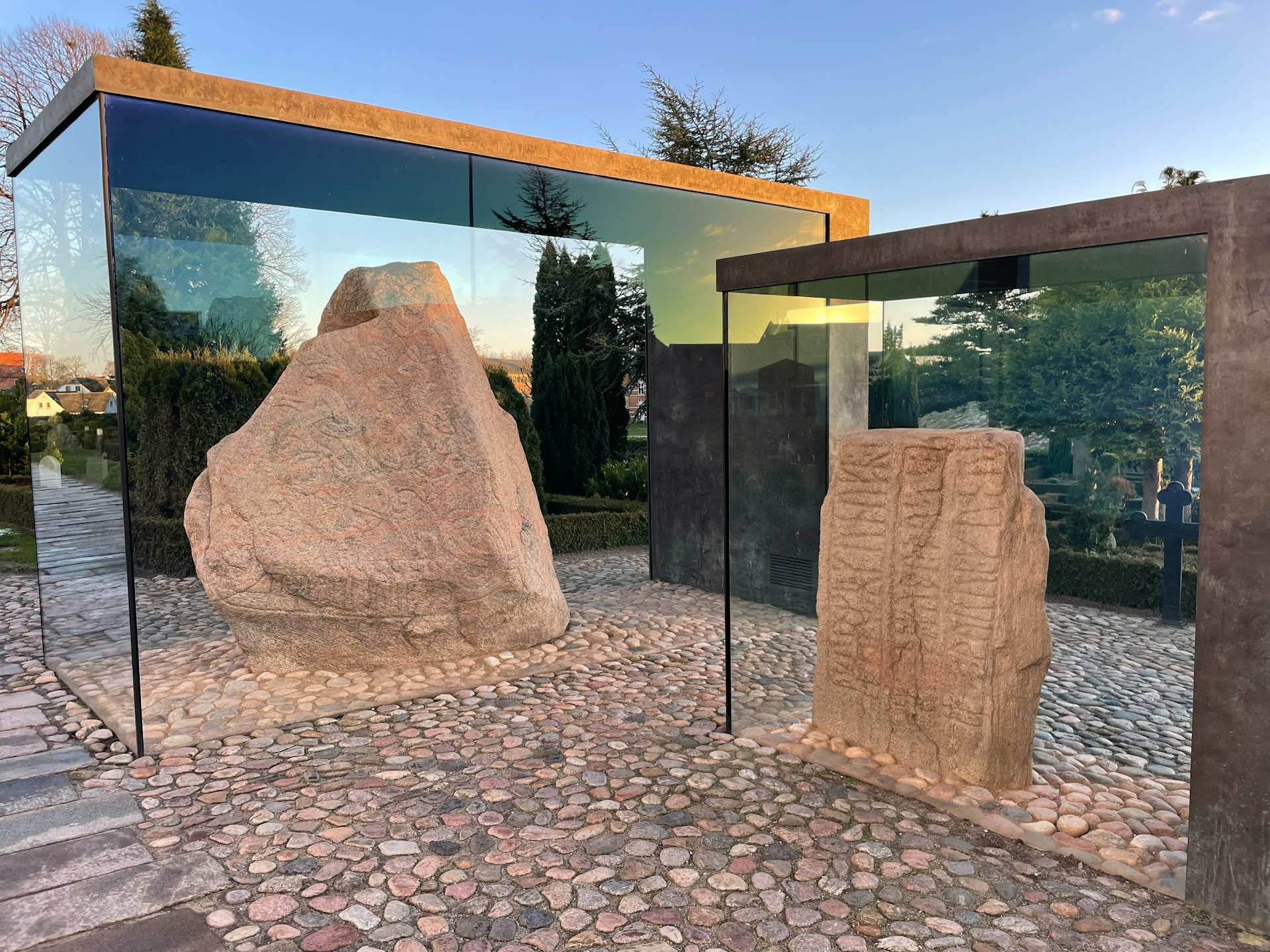
Jelling, Denmark. Two stones stand in the village of Jelling. The larger, about 7.9 feet tall, was raised around 965 by King Harald Bluetooth in memory of his parents.
In its inscription, the king boasts of having conquered “all of Denmark and Norway” and of having made “the Danes Christian.” One face bears one of the oldest images of Christ in Scandinavia. The stone is often called Denmark’s “birth certificate,” and since 1994 it has been a UNESCO World Heritage Site.
It is worth remembering that this is the king’s account of himself, not a neutral record. In fact, a couple of years ago a Norwegian archaeologist named Glørstad proposed that the stone might postdate the Viking Age, though other specialists disagree.
Rök, Sweden. This is the longest known runic inscription, with between 700 and 760 characters, depending on how they are counted. Carved around 800 in Östergötland, it was raised by a father in memory of his dead son.
So far, nothing unusual. The rest is another matter: it mixes different types of runes, uses at least two cipher systems and quotes heroic verses preserved nowhere else. No one has yet produced a reading that satisfies everyone.
Beyond Stone and Scandinavia
Runes were not reserved for monuments. In Bergen, Norway, archaeologists found wooden sticks bearing business notes, prayers, poems, love messages and even jokes. They amount to a kind of medieval WhatsApp, proof that runic writing was never the business of kings alone.
The Vikings also left their graffiti across the known world. In the upper gallery of Hagia Sophia in Istanbul, someone scratched a partly legible name into a marble balustrade. It is usually read as Halfdan, probably a member of the emperor’s Varangian Guard.
And the Neolithic tomb of Maeshowe, in Orkney, holds one of the largest collections of runic inscriptions outside Scandinavia.
They Didn’t End With the Vikings
Around 1100, the runes continued to evolve, giving rise to what are known as medieval runes, which remained in use until about 1500.
After that, they lingered in remote corners of Sweden, in forms such as the Dalecarlian runes. Counted from the first secure inscription, in the second century, to the very last, runic writing had a life of more than a thousand years.
It is also worth separating history from myth. In the poem Hávamál, preserved in 13th-century manuscripts, Odin hangs from a tree for nine nights to win the runes. It is a beautiful story, but it is literature.
Rune divination as practiced today is largely a modern invention. What the ancient stones actually say is far more earthbound: names, family ties, journeys and remembrance.
Where to See Them
For those who want to see them in person, there are several places to go. The Jelling stones remain in the village, beside the church, protected by glass.
In the Swedish province of Uppland, many stones still stand where they were first raised, along roadsides and at the edges of fields.
The Rök stone is in Östergötland. And in Istanbul, the Hagia Sophia balustrade invites you to picture a Viking guard killing time with a chisel.
In the end, perhaps that is what moves us most about runes: behind the kings and the battles, they preserve the small traces of people who simply wanted to be remembered.