Some photographs go viral and raise an immediate question: is there really a lake that turns animals to stone? The short answer is no. But the full story is far more interesting.
Lake Natron, in northern Tanzania, ranks among the most hostile environments on Earth. It is also the place millions of flamingos have chosen to raise their young.
A Vast Lake With No Outlet — and Barely Any Depth
Natron sits close to the Kenyan border, roughly 75 miles northwest of Arusha and northeast of the Ngorongoro Conservation Area.
It lies at an elevation of about 1,970 feet, on the floor of the Great Rift Valley, in the section known as the Gregory Rift — the eastern branch of the continental rift that runs the length of East Africa. About 16 miles to the north, just across the border in Kenya, lies another soda lake: Lake Magadi. To the south rises the Ol Doinyo Lengai volcano.
The dimensions are striking. The lake stretches about 35 miles from north to south, with an average width of about 9 miles and nearly 14 at its widest. Its surface area fluctuates between 330 and 400 square miles, depending on the source and the season.
But that expanse is deceptive, because the lake is very shallow. Its size shifts with the seasons — shrinking toward the end of the dry season, around October and November, then refilling during the rainy season, which lasts through April and May. In the dry months, the surface becomes blanketed by a salt crust that dissolves only when the rains return.
Natron has no outlet. Water comes mainly from the Ewaso Ng’iro River, which rises in Kenya, and from mineral-rich hot springs. The only way out is evaporation.
Under the equatorial sun, what’s left is an ever more concentrated brew of salts and minerals.
Why It Is So Extreme
The explanation lies a few miles away, in the Ol Doinyo Lengai volcano — “the Mountain of God” in the Maasai language. It is unique among volcanoes: the only one on Earth known to have erupted natrocarbonatite lava in historical times.
That lava is unlike any other. Rich in sodium and potassium carbonates, and nearly devoid of calcium and magnesium, it erupts at temperatures between 930 and 1,110 degrees Fahrenheit — far cooler than ordinary lava — which is why it looks black in daylight rather than red. On contact with moisture in the air, it turns white within hours.
Over thousands of years, those minerals washed into the lake. Concentrated by evaporation, they formed natron (which gives the lake its name) and trona, two alkaline salts.
The result is a caustic brine with a pH above 10 — some measurements place it close to 12.
For comparison, seawater hovers around 8. Then there’s the heat: water temperatures range from 104 to 140 degrees Fahrenheit.
Lake Natron is also startling to look at. During the dry season, as the water recedes, shades of red, orange, and pink bloom across the salt crusts.
The color comes from microorganisms — algae and cyanobacteria — that thrive in the brine, multiplying precisely where almost nothing else can.
Does the Lake Turn Animals to Stone?
This is where the myth begins. In 2013, photographer Nick Brandt published Across the Ravaged Land, featuring images of birds and bats encased in white mineral crusts, as though carved from stone. The photographs circled the globe.
The reality is less dramatic. Brandt found the animals already dead, washed up on the shore during the dry season, and posed them for the camera.
They do not turn to stone. Sodium carbonate dries on the carcasses and encrusts them, and the salts preserve the remains in a process not unlike mummification.
No one knows exactly how the animals die. What is clear is that the lake does not turn animals to stone.
The Flamingo Sanctuary
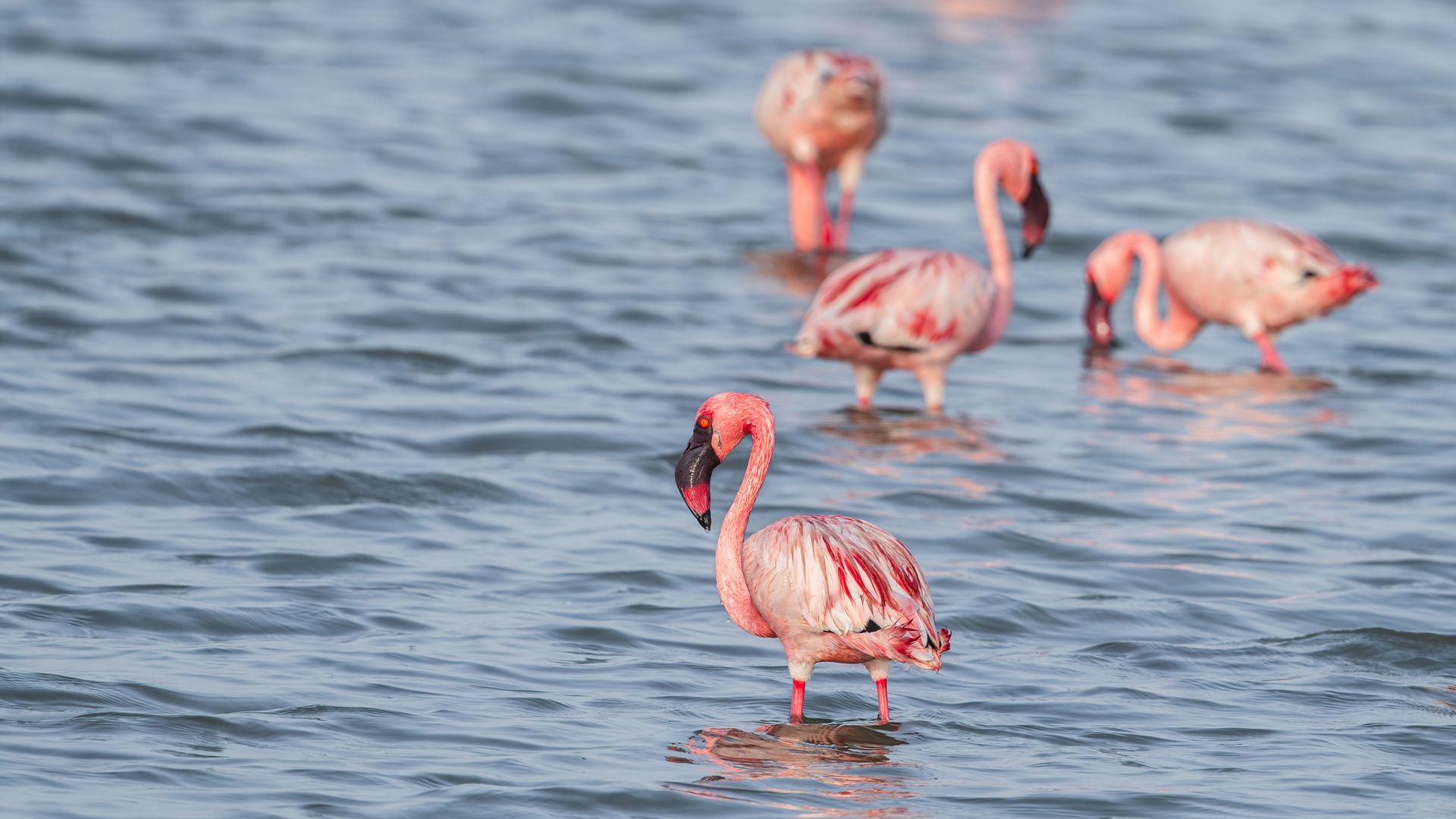
And here is the great paradox. Natron is the main breeding ground for lesser flamingos in East Africa, hosting up to 2.5 million birds at its peak. The IUCN lists the lesser flamingo as Near Threatened.
Flamingos can survive here because their legs are protected by tough, alkali-resistant skin, and because they feed by filtering cyanobacteria from the water with their bills. But the real reason is simpler: almost no predator can tolerate these conditions.
For a flamingo, that hostility is a fortress. Their nests, built on small islands of mud and salt surrounded by caustic water, lie safely out of reach.
The lake also supports a small population of alkaline tilapia — endemic fish that shelter in the cooler pockets where freshwater springs feed into the lake.
A Fragile Ecosystem
In recognition of its ecological value, the Lake Natron basin was designated a Ramsar site — a wetland of international importance — on July 4, 2001.
Even so, its future was once in doubt. In the early 2000s, a proposal emerged to build a sodium carbonate processing plant on the lake’s shores — a project that conservationists argued would have devastated flamingo breeding. In 2008, Tata Chemicals announced it would not proceed, and any future proposal would have to be weighed against the wetland’s management plan.
Today, the main threats are mining and the diversion of water from the rivers that feed the lake.
How to Visit
Natron is a remote destination, well off the classic safari circuit.
The drive from Arusha takes five to six hours, with the final stretch on rough dirt tracks — a four-wheel-drive vehicle and a local guide are strongly recommended. The usual base is Engare Sero, a Maasai village where most excursions begin.
The best time to visit is the dry season, June through October, though the heat is intense.
Activities include a hike to the Engare Sero waterfalls, where you can swim, and the climb up Ol Doinyo Lengai — a tough ascent that usually starts before dawn.
A word of caution: wear sturdy footwear near the shore, where the ground can be dangerously hot, and avoid contact with the water itself.
A Lake That Protects What It Seems to Destroy
Natron defies expectations. Its water can burn skin, its heat is barely tolerable, and its shoreline is strewn with salt-preserved remains. Everything about it suggests a lifeless place.
And yet it is precisely that harshness that keeps the flamingos safe — driving away nearly everything that might threaten them.
The greatest danger to these birds is not the lake. It is what humans might do to it: an industrial plant, a dam on the rivers that sustain it. Perhaps that is the lesson Natron teaches. Sometimes the most inhospitable place is the one that offers the best protection.