

The Kumano Kodo, often called the Japanese Camino de Santiago, is one of Japan’s most storied pilgrimage routes.
Its trails wind through legend, hot springs, and ancient cedar forests before arriving at three sacred Shinto shrines: Hongu Taisha, Hayatama Taisha and Nachi Taisha, deep within the Kii Peninsula.
Once walked by emperors, these routes now welcome pilgrims and travelers from around the world. And yet the essence of the journey has not changed.
At its core, Kumano Kodo is an act of introspection — a way of purifying the body and quieting the soul.
The History Behind the Kumano Kodo
As its name suggests, the Kumano trails are not a single path but an extensive network of routes connecting three sacred shrines. For more than 1,000 years, they have drawn pilgrims and travelers from across the world in search of a more spiritual Japan.
The Kumano Kodo reached its greatest prominence during the Heian period, between 794 and 1185 A.D.
In those years, emperors would set out from Kyoto with their full retinue on an exhausting 30-day journey, seeking the favor of the deities believed to inhabit the rocks, rivers, and trees of Kumano.
Along the way, the emperors made ceremonial stops. Dance, song, poetry, and ritual bathing in the region’s many tributaries were all part of the tradition.
The presence of water is no accident. In the Japanese worldview, Kumano is the “land of purity” — a threshold where the world of the living touches the world of spirits.
What truly sets the Kumano Kodo apart from other pilgrimage routes, however, is its religious harmony. Here, there is no boundary between Shinto — the native faith in which every element of nature holds a spirit, or kami — and Buddhism, which arrived in Japan through China.
For centuries, both traditions have coexisted in these mountains. Pilgrims pray freely before a waterfall as a living spirit, while also recognizing that same spirit as a manifestation of the Buddha.
Kumano Kodo is, in the most literal sense, the coexistence of gods and buddhas on a single path.
The Imperial Route: Nakahechi
Of all the routes within the Kumano Kodo network, the Nakahechi route is without question the most iconic. Historically the preferred path of the imperial family and the court nobility, it is known simply as the imperial route.
The trail runs along the western coast of the Kii Peninsula, passing through dense forests and mountain terrain. It covers roughly 25 of the Kumano Kodo‘s 186 total miles.
The route can be walked in stages, and unlike in the imperial era, it is now possible to combine certain sections with public transportation.
The journey begins at Takijiri-oji, where a simple stone torii marks the entrance to the Kumano mountains.
There is no fixed itinerary. The walk can take two days or a full week, depending largely on the kind of experience you are looking for and the places you want to linger in.
Whatever pace you choose, one thing becomes clear almost immediately: the pilgrimage moves through the wild, mountainous heart of the Kii Peninsula. The ascents are steep and demanding, a natural obstacle course where massive cedar roots claim the trail as their own.
In Kumano Kodo, nature is not the backdrop — it’s the star of the show. Every step costs something. Every breath becomes deliberate. The forest wraps around you in a deep silence broken only by the distant sound of a stream.
The Oji and the Ritual of Water
Along this route — the most traveled today for its accessibility and beauty — pilgrims pause repeatedly at the Oji.
These small wayside shrines function as stations of protection and rest. They are the places where pilgrims leave offerings and catch their breath before pressing on toward the great shrines of Kii.
A similar spirit of renewal awaits at Yunomine Onsen, a thermal village with more than 1,800 years of history. It is an invitation to undergo the purification ritual considered essential before approaching the great deities.
At the center of that experience is Tsuboyu, a small wooden bathhouse built over the river.
It houses the only thermal bath in the world designated a UNESCO World Heritage Site where visitors are actually allowed to bathe.
Its medicinal waters are said to change color seven times a day and to carry a mystical power said to restore the spirit.
To bathe there is a rite of passage. The heat rising from the earth melts away the fatigue in your legs after the climbs through the roots of Takijiri, preparing you for the imminent arrival at Hongu Taisha — the first of the Kumano Sanzan.
Kumano Sanzan: The Three Pillars of Faith
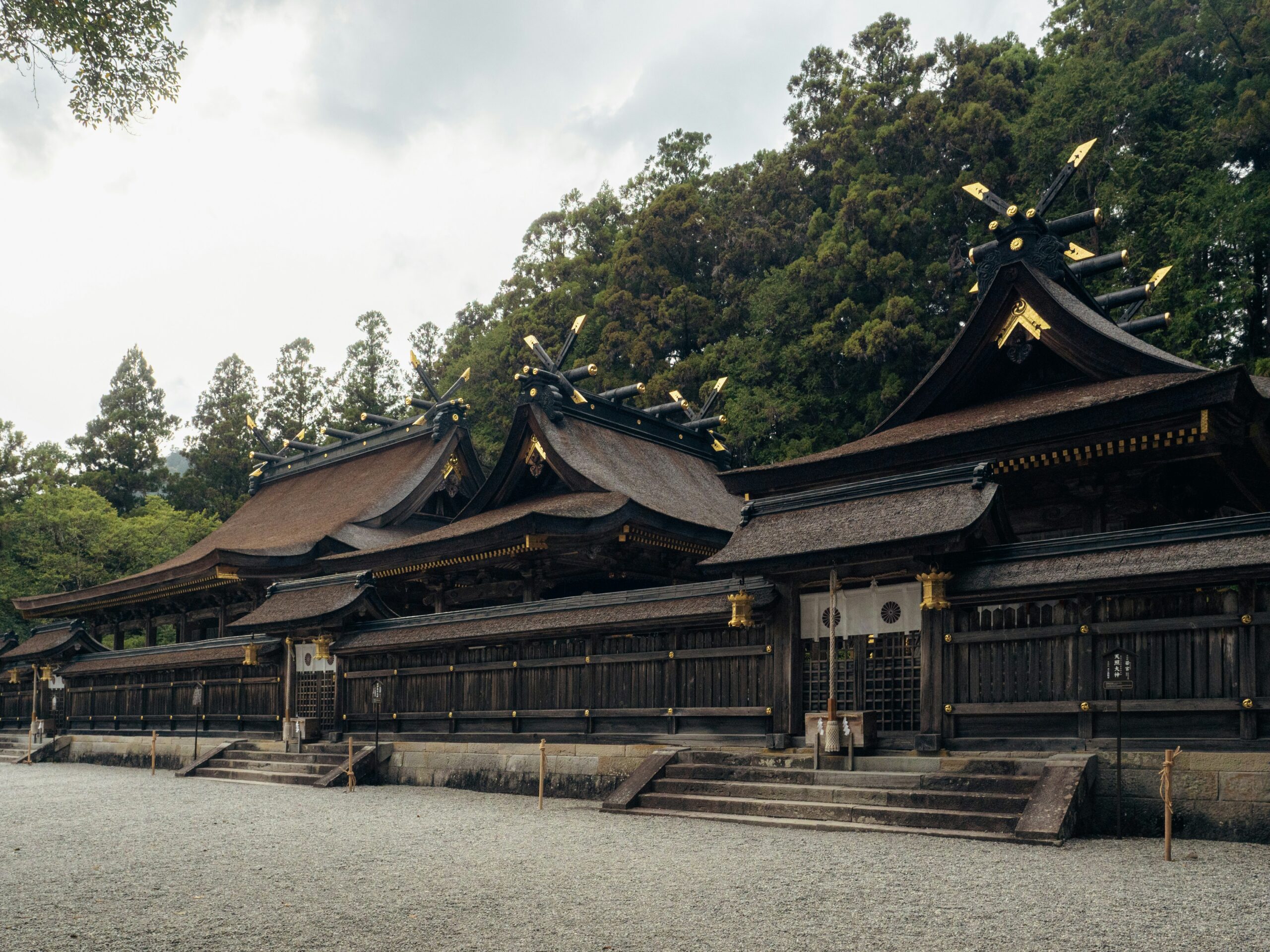
After days of walking through mist and moss, the trail finally delivers you to the three great shrines of Kumano, known collectively as Kumano Sanzan. Each has its own character and aesthetic, reflecting a distinct stage of the spiritual journey.
Set in the heart of the mountains, Kumano Hongu Taisha is the nerve center of all the routes.
Not far from it stands Oyunohara, home to the largest torii in the world at 108 feet tall. This structure marks the original site of the shrine before a great flood swept it away in 1889. Its monumental scale has a way of making whatever you were worried about feel very small.
At the mouth of the Kumano River stands Kumano Hayatama Taisha, the second of the shrines.
It blazes in a deep vermilion that cuts sharply against the surrounding green. Nature is venerated here in its purest form, centered on a sacred Nagi tree more than 800 years old — a symbol of longevity and peace.
The pilgrimage ends at Kumano Nachi Taisha.
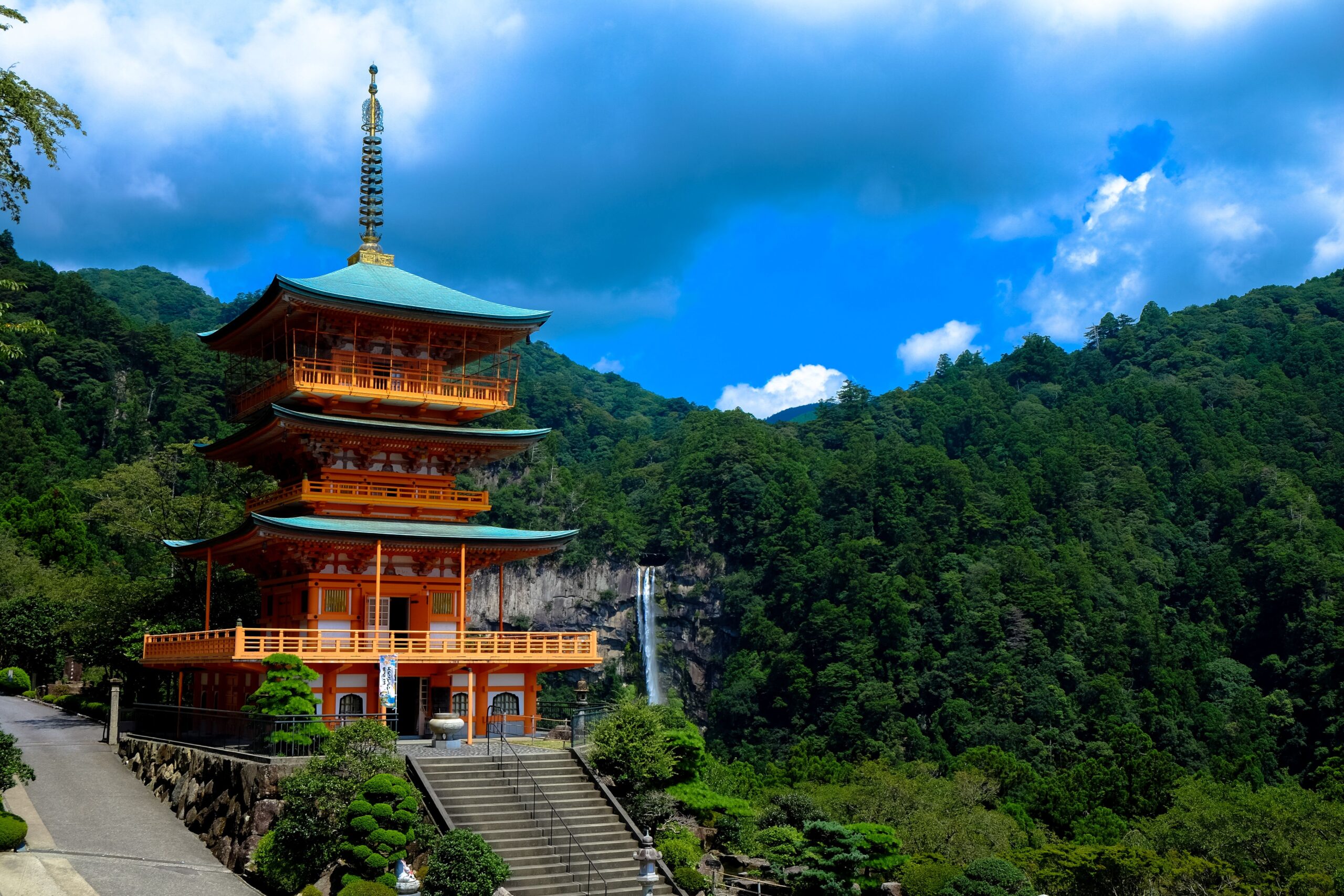
Here, spirituality turns vertical. Beside the shrine, the 436-foot Nachi-no-Otaki cascade falls, venerated as a deity in its own right. The image of the three-tiered pagoda rising against the waterfall is the visual climax of the entire journey.
Life on the Trail: Shukubo and Buddhist Cuisine
While there are many lodging options along the Kumano Kodo, fully immersing yourself in the pilgrimage experience all but requires spending at least one night in a Shukubo — a temple lodging.
In villages like Koyasan and at small stops along the Nakahechi route, monks open their doors to travelers, offering a refuge of simplicity and silence.
Sleeping on a futon in a tatami room, with the scent of incense drifting through the corridor, puts you in the right frame of mind for Shojin Ryori — the traditional Buddhist cuisine that is strictly vegetarian, built around the principle of five colors and five flavors.
Fresh tofu, lotus root, mountain vegetable tempura, and miso soup arrive arranged like small works of art.
This is not merely food. It is a lesson in gratitude for what the earth provides — an extension of the reverence for the kami that the pilgrim has been quietly cultivating all day long.


