

The churches of Lalibela, in northern Ethiopia, defy architectural logic.
While other civilizations raised temples toward the sky, the people of the Amhara region drove downward into volcanic basalt, hollowing out a sacred underground city from the living rock.
To understand how this came to be, you have to look back — to the Kingdom of Aksum.
This empire flourished between the 1st and 7th centuries A.D. and ranked among the most powerful states of the ancient world, a peer of Rome, Persia, and China. It was also the first great African state to adopt Christianity, in A.D. 330.
Today, this cluster of churches at the heart of the Ethiopian highlands endures as the greatest legacy of an era when architecture turned inward, into the earth itself.
From the Kingdom of Aksum to the Churches of Lalibela, the Carved “New Jerusalem”
In the small city of Aksum, granite monoliths standing more than 65 feet tall still mark the tombs of ancient kings.
What makes these stelae remarkable is not merely their scale, but their precision. They were carved with astonishing realism, imitating multi-story buildings complete with door frames and windows.
In some ways, they anticipated the technical mastery that would emerge centuries later in the churches of Lalibela.
But Aksum was more than an engineering achievement. It was the spiritual heart of the country.
According to the tradition of the Ethiopian Orthodox Church, the city guards the original Ark of the Covenant — brought from Jerusalem, the story goes, by Menelik I, son of King Solomon and the Queen of Sheba.
Regardless of the archaeological evidence, that narrative gives the region the aura of an “African Holy Land” and explains why faith has shaped the landscape so radically.
But there is a historical question worth asking: why did a civilization that built giant obelisks eventually begin hiding churches underground? The answer lies in the fall of the Kingdom of Aksum.
Its decline was not sudden. It unfolded slowly, across the 7th and 8th centuries, driven by the expansion of Islam, which seized control of the Red Sea trade routes. Cut off from its key ports, the empire was isolated from the outside world, and its economy collapsed.
Environmental pressure compounded the crisis. Centuries of intensive agriculture had eroded the plateau’s soil, triggering famines that hollowed out central authority.
Then, in the 10th century, tradition holds that a conquering queen named Gudit sacked the capital, destroying monuments and forcing the population into the highlands and the remote, inaccessible reaches of the interior.
It was from this crucible of resistance that the Zagwe dynasty emerged — and with it, the vision of King Gebre Meskel Lalibela. Unable to reach the physical Jerusalem, he set out to carve a spiritual one into the mountains of his own kingdom.
The result was the 11 medieval churches of Lalibela. Cut entirely from the bedrock, they required no transported materials, no mortar, no construction in the conventional sense.
Artisans worked from the top down, cutting deep trenches into the basalt until a freestanding block of stone rose from the center. From that block, they sculpted facades, columns, ceilings, and interior chambers — all from a single piece of earth.
The Stone Labyrinth: The Principal Churches
The Lalibela complex is divided into two main groups. The northern group represents earthly Jerusalem, while the eastern group symbolizes heavenly Jerusalem.
Among them, several structures stand apart for their technical complexity and state of preservation. Chief among these is Bete Medhane Alem (the House of the Savior of the World), the largest monolithic church in the world.
Its exterior, ringed by 34 carved columns, recalls a Greek temple. But what’s truly staggering is this: the entire volume — roughly 36 feet tall and nearly 8,600 square feet of floor plan — was extracted from a single block of rock, without a single brick added.
Bete Amanuiel (the House of Emmanuel) is, for many art historians, the most refined of the group. Its facade faithfully replicates the architectural style of the ancient Kingdom of Aksum, with projections and recesses that mimic wooden beams and layered stone.
Among the churches of Lalibela, Bete Aba Libanos stands in a category of its own. It is a hypogeum — a structure built entirely or partly below ground level.
Yet only its roof and base remain attached to the rock. Its four walls are separated from the mountain by a corridor, giving the impression that the building stands free, even though it is still part of the mountain itself.
Bete Maryam (the House of Mary) is probably the oldest of the churches and the one with the richest interior decoration. Its ceilings are covered in frescoes and reliefs depicting biblical scenes and geometric motifs — pigments still vivid after centuries of humidity and shadow.
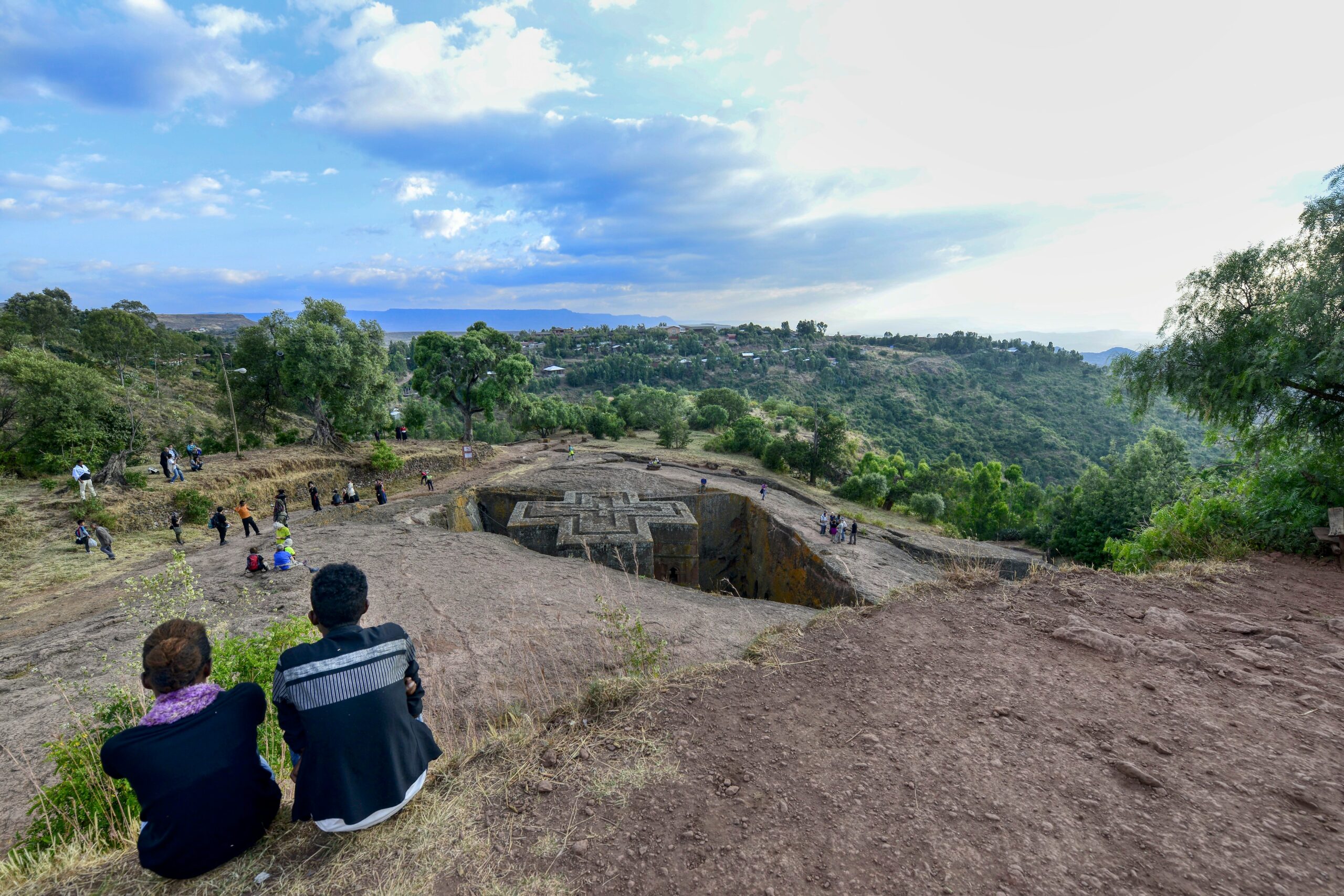
But the undisputed crown jewel is Bete Giyorgis (the Church of St. George). It is the most celebrated and the last to be built. Unlike the other ten churches in the complex, which are clustered together, this one stands alone in its own pit.
From the edge of the precipice, all you see is a perfect Greek cross carved into a stone roof set flush with the ground. To enter, you descend through a narrow hand-carved canyon that opens onto the base of the church.
Once inside, you feel very small — vertical walls of reddish rock enclosing a three-story building that seems to have risen from the earth by some inexplicable force.
A Practical Guide for the Curious Traveler: How to Visit the Churches of Lalibela
The churches of Lalibela are not a place you pass through. They require deliberate effort — and, above all, planning.
The most practical way to arrive is by domestic flight from Addis Ababa, Ethiopia’s capital, to Lalibela Airport. Once there, plan on at least two full days to explore both groups of churches at the pace they deserve.
When to go: The best time to visit is between October and March, during the dry season. For a more immersive cultural experience, Jan. 7 brings the celebration of Genna — Ethiopian Christmas — when thousands of pilgrims fill the church courtyards.
Logistics: Hiring an official guide at the visitor center is mandatory. Not just for the historical context, but because the network of tunnels and passageways can be genuinely disorienting.
Where to stay: For an experience that honors the aesthetic of the place, Maribela Hotel is the standout choice. Popular with travelers drawn to traditional Ethiopian design, it features balconies inspired by the carved churches themselves and sweeping views of the Gheralta mountains.
To descend into the churches of Lalibela is, in the end, to witness what a civilization did when history closed in around it — not surrendering to the stone, but carving its own destiny into it, on a scale as monumental as the carved stone ruins of Petra.



