

Lost among the dense green mountains of northern Haiti, a skeleton of red brick refuses to disappear.
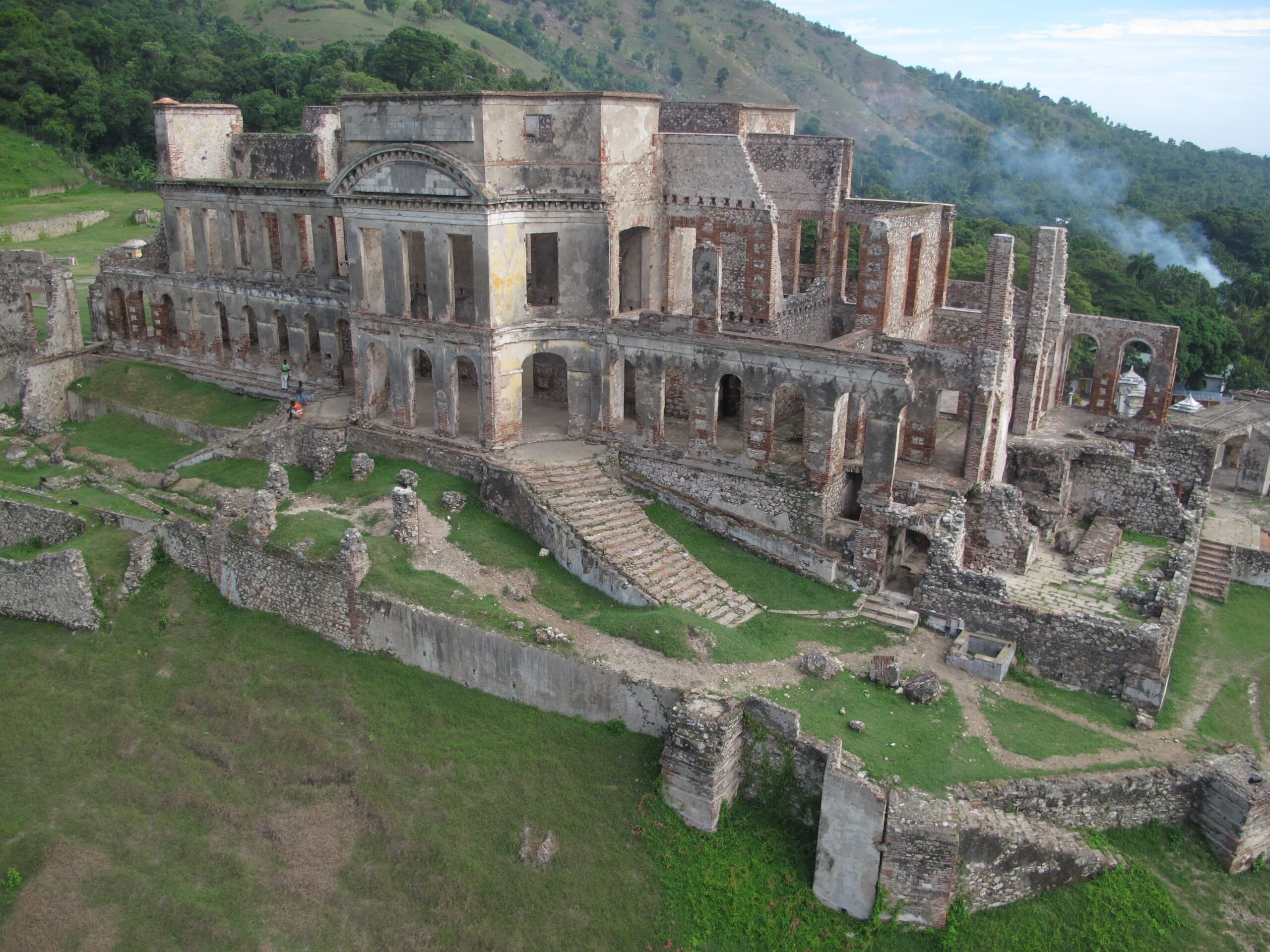
It is what remains of what was once the symbol of the first postcolonial kingdom in the Americas: Sans-Souci.
Located in the town of Milot, the ruins of the Palace of Sans-Souci see more silence than visitors.
Haiti, with its chronic political instability, remains almost entirely off the conventional tourist map.
While crowds pack the resorts of neighboring Dominican Republic, Haiti remains frozen in time, holding treasures that seem to belong to another age entirely.
Sans-Souci, the “Versailles of the Caribbean,” is the most enigmatic of them all.
The Sans-Souci Palace: The Versailles of the Caribbean that went from European opulence to decay
Unlike its French counterpart, the “Versailles of the Caribbean” did not survive the ravages of time and the elements.
Built in 1811 by Henri Christophe—a freed slave, revolutionary general, and self-proclaimed monarch—the Sans-Souci Palace was built to prove the refinement and sophistication of Black people to the European powers—France above all.
But to truly grasp what Sans-Souci signified, one must travel back in time and understand the geopolitical context.
In 1804, after defeating Napoleon’s troops, Haiti became the world’s first Black republic.
However, that very audacity also became its undoing. The colonial powers (France, Great Britain, Spain) and the rising United States feared that the Haitian “virus of liberty” would infect their own slave colonies.
Haiti stood alone. No one recognized its independence. In this context, the Sans-Souci Palace was born as a cry for legitimacy.
Christophe wanted a European envoy arriving at his court to encounter not a former slave, but a true monarch reigning from the comfort of a palace that could rival any in Europe.
If Versailles was the symbol of Louis XIV’s absolutism, Sans-Souci was the symbol of Black sovereignty.
Henri Christophe’s ambition materialized in this neoclassical palace, complete with ballrooms, libraries, and French gardens.
European luxury—marble floors, precious stones, imported tapestries, and paintings—was complemented by an innovative cooling system that kept the palace cool in Haiti’s stifling tropical heat.
Sans-Souci was a genuine marvel of engineering for its time and place.
But it was much more than a building. It was a stage where Christophe imposed a court etiquette as strict as any across the ocean.
Dukes, counts, and barons were required to wear formal European dress under the blazing Caribbean sun. Festivities, banquets, and the royal guard (the “Dahomets”) mirrored the pomp of European monarchies.
Though, of course, it came at a high price. Even though Sans-Souci means “carefree,” its construction cost the lives of thousands of workers, and its opulence served as the backdrop for an iron-fisted regime.
It is even said that in 1820, Christophe himself committed suicide with a silver bullet in his quarters, after suffering a stroke and seeing his power slip away.
The Shadow of the Citadelle: The Refuge of Paranoia
This European elegance was one side of the coin; on the other was the face of war.
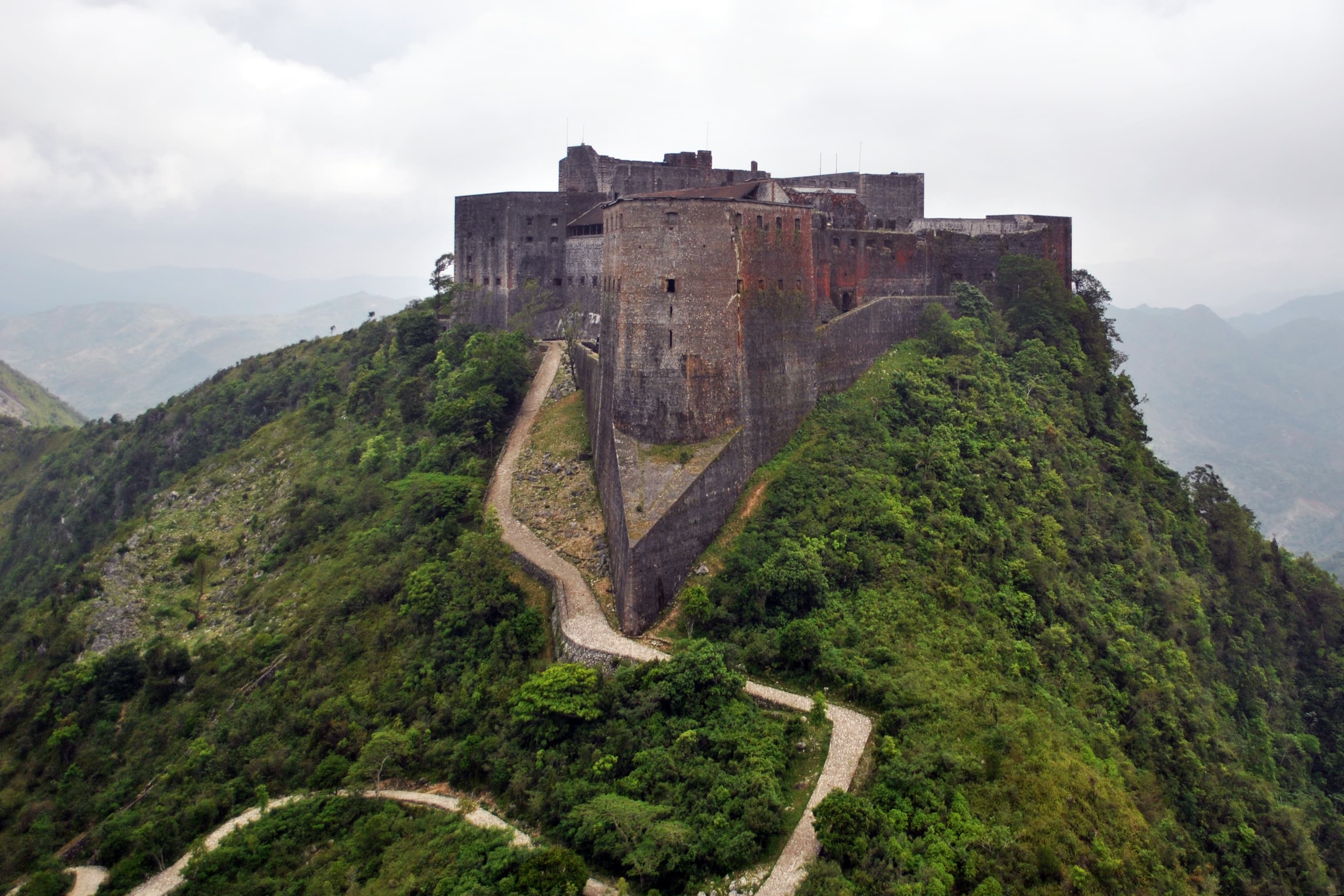
Behind the ruins, atop Pic Laferrière, the Citadelle keeps watch.
While Sans-Souci was the setting for diplomacy and dancing, the Citadelle—the largest fortress in the Western Hemisphere—was the ultimate bastion of resistance.
Christophe, living under the constant paranoia of a French return, gave the order to build an impregnable fortress.
Its construction was a feat of human endurance and desperation. For 13 years, thousands of men dragged stone blocks and heavy bronze cannons up the punishing slopes.
From its vantage point 900 meters above sea level, it offered a sweeping panorama of the mountains, stretching all the way to the Caribbean. From here, Christophe’s lookouts could detect any French sail before it even touched the coast of Cap-Haïtien.
Thus, while Sans-Souci represented civilization, the Citadelle represented survival.
Its structure was designed to shelter 5,000 soldiers and the royal family during a year-long siege, featuring water cisterns and storehouses as vast as the king’s terror of being returned to chains.
At the first cannon shot on the horizon, the entire court was to abandon the tapestries and take refuge in this eagle’s nest that still dominates the clouds today.
Yet the enemy never returned, and hundreds of cannons still point toward the horizon—or at least, what remains of them does.
In 1842, an earthquake buried the era of the Black kings. What the tremor didn’t destroy, the encroaching jungle did.
Today, to walk through Sans-Souci is to witness a silent struggle, as European geometry surrenders to the wild, untamed growth of the island.
Mini-Guide for the Curious Traveler
Reaching Milot to visit the National History Park, which houses the ruins of Sans-Souci and the Citadelle, is an exercise in logistics and patience.
The fastest route is to fly into Cap-Haïtien International Airport. From there, a 30-minute drive leads to the town of Milot, though you’d be wise not to go alone but with a local guide.
A half-day is enough for the visit, starting with the palace ruins and then ascending to the Citadelle. For the latter, there are two options: rent a horse from the locals or take a demanding 45-minute hike under the tropical heat and humidity.
There are no interactive panels or state-of-the-art audio guides. Your own intuition will lead you through Sans-Souci, and the overgrown ruins themselves will tell their story.
It is, quite possibly, one of the few places left in the world where you can still feel like a 19th-century explorer, stumbling upon a lost civilization in the middle of the modern world.



