
More than 3,500 years ago, the Minoan civilization built one of the most fascinating sites in the Mediterranean: the Palace of Knossos, home to the legendary King Minos and birthplace of some of the most iconic myths of Ancient Greece.
You’ve likely heard of the myth of the Minotaur of Crete, a creature — half man, half bull — who lived inside a labyrinth and was eventually slain by Theseus.
What you may not know is that this legend is tied to Knossos, which was more than just a royal residence — it was an architectural and engineering marvel for its time.
Built in the 19th century BCE, Knossos is remarkable not only for its archaeological value but also for its deep connection to Greek mythology.
Let’s travel back in time to explore the largest archaeological site on Crete and one of the most significant in Greece.
The Palace of Knossos Through Time: From Its Construction to Its Discovery
Despite numerous archaeological findings, no one today knows who originally designed the Palace of Knossos, although Greek mythology attributes its design to the legendary Daedalus, who also designed the famous Minotaur labyrinth.
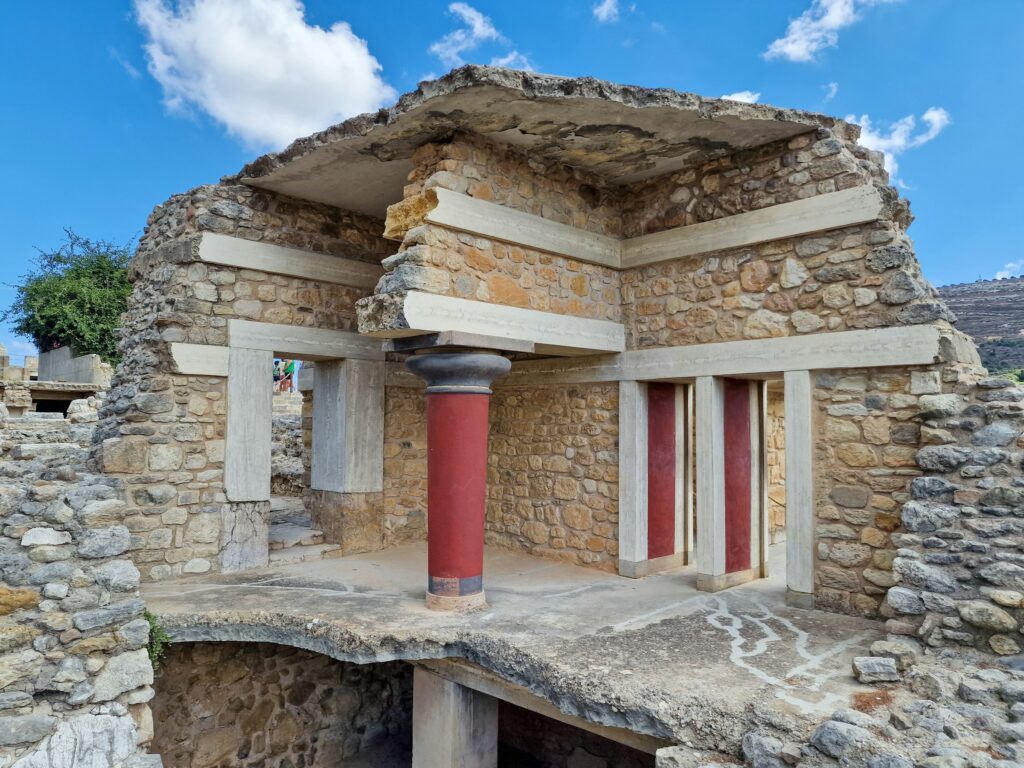
The Minoans were one of the most advanced civilizations in Europe. It’s no surprise that Knossos featured running water, an exceptional drainage system, colorful frescoes, multiple floors, and corridors so intricate that they continue to fuel the myth of the Minotaur.
Knossos was far more than a royal residence. It was the political, religious, and economic center of Minoan life.
In the Throne Room, one of the best-preserved sections, it’s believed that King Minos presided over rituals and ceremonies, as suggested by the frescoes adorning its walls.
Over the centuries, the Palace of Knossos endured the ravages of time and nature — including the Thera eruption, which devastated the island of Santorini 3,600 years ago. It was also captured by the advancing Mycenaeans from mainland Greece and eventually abandoned.
But Knossos was never truly lost — it remained buried, waiting centuries to be unearthed.
Arthur Evans and the Rediscovery of the Palace of Knossos
For centuries, the existence of the Minoans seemed more legend than reality. But when archaeologists began excavating the legendary Palace of Knossos, they confirmed that this ancient civilization had truly existed.
The work of archaeologists and historians helped bring to light Europe’s oldest city — Knossos.
But it was the excavation led by British archaeologist Sir Arthur Evans that revolutionized the study of Minoan civilization.
In just over two years, Evans uncovered much of the Palace of Knossos, including the famous Throne Room, the Central Courtyard, and vibrant murals across the palace walls.
Among his most important discoveries were clay tablets over 3,000 years old, written in the mysterious Linear A script, which remains undeciphered to this day.
Thanks to Evans’ tireless work, the world learned that before the Mycenaeans, a sophisticated civilization had thrived with remarkable artistic and architectural achievements — the Minoans.
German archaeologist Heinrich Schliemann had already tried to locate the palace in 1894, encouraged by discoveries made by Minos Kalokairinos, widely regarded as the true discoverer of Knossos. Kalokairinos, a merchant from Heraklion and amateur archaeologist, is often credited with the original discovery of Knossos.
In 1878 — long before Evans set foot on the island — Kalokairinos carried out preliminary excavations on Kefala Hill, uncovering large storage jars and architectural remains that hinted at a palatial complex.
But Evans went further. He not only revealed the Palace of Knossos but also connected it with King Minos and the famous Minotaur myth. Together with architect Christian Doll, he led a controversial reconstruction of the palace using concrete, wood, and iron beams to restore its grandeur.
While the restoration was criticized for lacking historical accuracy, the materials did help the complex survive the 1926 earthquake.
Thanks to Evans, millions of people today can walk through Knossos and experience one of the most fascinating sites of the ancient world firsthand.
The Palace of Knossos and the Myth of the Minotaur
The connection between Knossos and the Minotaur is no coincidence. According to mythology, King Minos commissioned Daedalus to build a labyrinth so complex that no one could escape it. There, he imprisoned the feared Minotaur, a creature born of a divine curse.
For years, Athens was forced to send its young as tribute to feed the creature. The last was Theseus, who — with the help of Ariadne, daughter of King Minos — ventured into the maze and killed the Minotaur. To avoid getting lost, he tied a thread to the entrance, unraveling it as he went deeper — the famous “Ariadne’s thread.”
When Evans discovered the palace’s labyrinthine layout — with multiple floors, corridors, and interconnected rooms — he believed it confirmed the myth. He was the first to propose that the Palace of Knossos had inspired the legend.
Today, many archaeologists no longer believe in a physical labyrinth, but there’s no doubt that walking through Knossos is like stepping into a story where myth and reality blur.
You might not encounter a Minotaur, but you’ll find a living testament to the ingenuity, imagination, and grandeur of one of the most remarkable civilizations of the ancient world.