

The sea slug that photosynthesizes is real, and it measures less than half an inch.
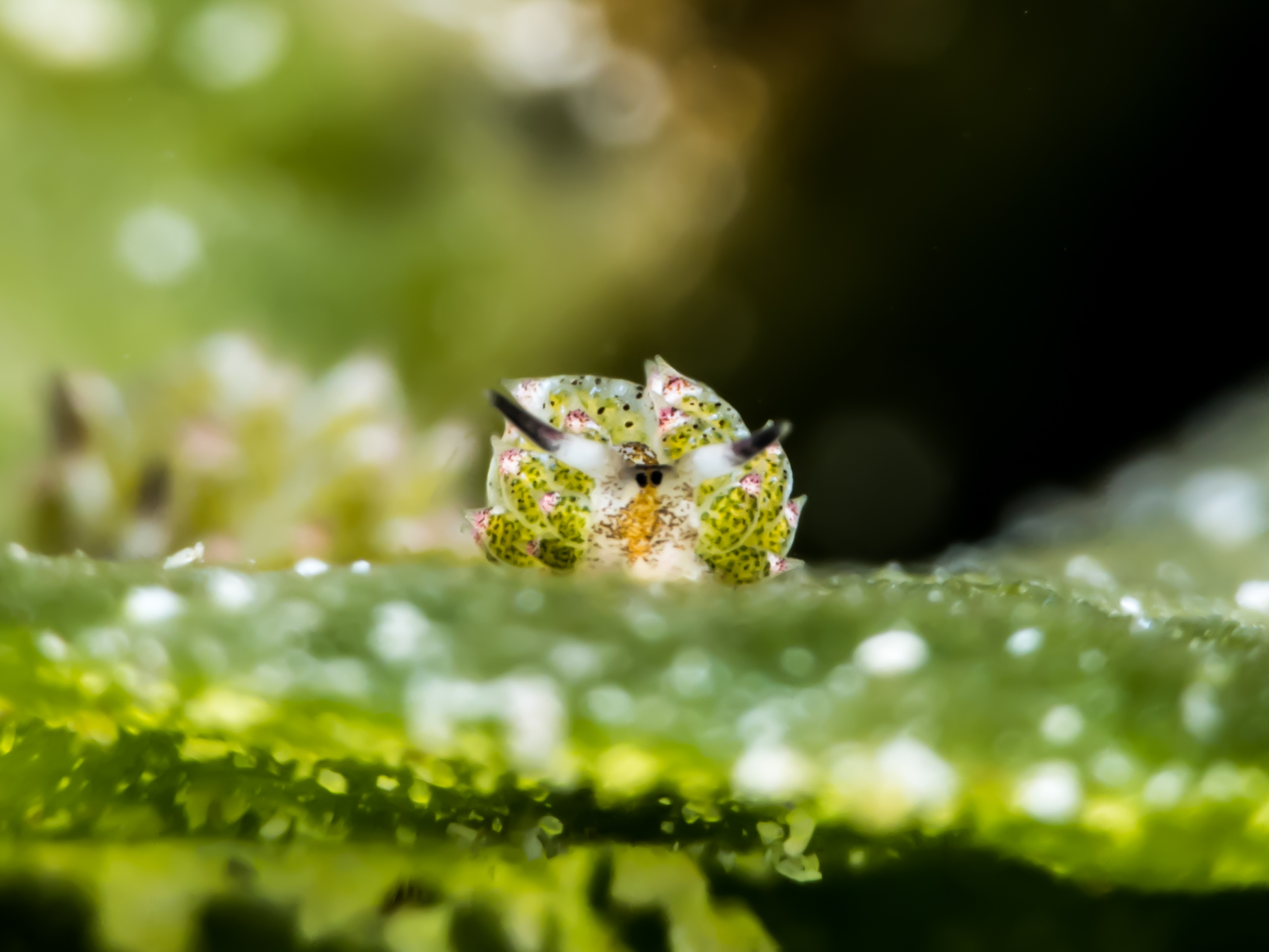
Known as Costasiella kuroshimae, it is a shell-less mollusk belonging to the group known as sacoglossa.
When it feeds on algae, it does not simply digest the cells. It extracts the chloroplasts intact and keeps them alive inside its own body, where they continue capturing sunlight for days.
Cellular Theft With a Name of Its Own
The process is called kleptoplasty, from the Greek for “stolen plastids.”
Rather than destroying the chloroplasts it consumes, the slug incorporates them whole.
Those organelles take up residence in specialized cells lining the animal’s digestive tract, distributed across the green, leaf-shaped protrusions that cover its back and give it the appearance of a tiny tuft of living moss.
That appearance is precisely why divers have given it a nickname: the “leaf sheep.”
Costasiella kuroshimae was first described in 1993 by researcher Ichikawa, based on specimens collected near the Japanese island of Kuroshima, which lends the species its scientific name.
It measures between about a fifth and two-fifths of an inch and is found in the waters of Japan, the Philippines, Indonesia, and Guam—always in close association with a specific green alga of the genus Avrainvillea, its only food source and, by extension, its only source of chloroplasts.
What the Chloroplasts Do Once Inside the Slug
A 2014 study published in the Journal of Molluscan Studies examined the photosynthetic capacity of five species within the genus Costasiella and confirmed that three of them retain functional chloroplasts.
Among those three, there’s a distinction that popular coverage rarely mentions.
Costasiella ocellifera keeps its chloroplasts active for several weeks, while Costasiella kuroshimae—the species known as the leaf sheep—belongs to the short-retention group, with chloroplasts that remain functional for only days, not weeks.
While active, those chloroplasts continue fixing carbon dioxide and producing energy-rich compounds, just as they would inside the alga itself.
The same study revealed something that complicates the appealing image of animal photosynthesis.
Costasiella ocellifera survived at least 38 days in complete darkness, demonstrating that chloroplasts are not essential to the animal’s survival.
The researchers suggest they function more as an emergency nutrient reserve than as a primary, continuous energy source.
Why the Slug Does Not Become a Plant
Kleptoplasty is not a merger of animal and plant.
The slug does not absorb the algal cell’s nucleus, nor does it acquire the genetic machinery needed to manufacture new chloroplasts.
It simply holds onto, for a limited time, the ones that already existed inside the alga it ate. When those organelles degrade, the slug must feed again to replenish them.
This phenomenon is not unique to Costasiella.
It appears in other sacoglossan genera as well, including Elysia, though with varying degrees of efficiency and duration depending on the species.
Within that group, Costasiella represents one of the best-documented cases of short-term retention, and its study helps researchers understand how this capacity evolved independently across different branches of the sacoglossan family tree.
An Anatomy Built for Invisibility
The green color of Costasiella kuroshimae is not skin pigmentation. It is the direct expression of chloroplasts lodged beneath the animal’s translucent surface.
Its cerata—the leaf-shaped protrusions covering its back—concentrate the highest density of chloroplasts and also serve as camouflage among the algae on which it feeds.
The rhinophores, two sensory structures on the animal’s head, allow it to chemically detect the presence of Avrainvillea on the substrate before it even approaches to feed.
That dependence has a hard deadline measured in days.
The chloroplasts the slug steals do not regenerate or divide inside its body. They exhaust themselves, lose activity, and must be replaced with every new meal.
So Costasiella kuroshimae lives in a constant cycle of eating and absorbing light—neither function sufficient on its own to sustain it.
It is, as far as science can currently see, one of the few animals that literally needs sunlight to round out its diet.