
Before bones adorned the walls of the famous Paris Catacombs, there was a cemetery that quite literally collapsed in the heart of the city. Walls cracked under the weight of the dead, and even pigs were seen rummaging through human remains. It sounds like fiction — but it really happened.
This is the story of the Cemetery of the Innocents, the most haunting place in Parisian history.
The Cemetery of the Innocents and the Medieval Scene No One Talks About
Let’s travel back in time. The Middle Ages. Present-day Les Halles, Place Joachim-du-Bellay. What today appears to be merely a charming square in the heart of Paris was once the final resting place for thousands of Parisians.
Directly across from the Church of the Holy Innocents stood the city’s oldest and busiest cemetery.
For centuries, this graveyard, surrounded by high stone walls, received the remains of thousands: ordinary citizens, nobles, victims of the Black Death, martyrs—even unbaptized children, buried in a special corner.
What began as a modest cemetery eventually became a mass grave, and ultimately, a stark symbol of a city overwhelmed by its own dead.
Les Innocents became the largest cemetery in Paris. There was no more space for burials, yet the dead kept coming. A single pit, 20 meters deep, could hold up to 1,500 bodies. The soil became saturated with decaying corpses, with consequences the city could no longer ignore.
The stench seeped through the walls of nearby homes. In warm weather, the air was unbreathable. Residents claimed that diseases were rising from the very ground.
But the most chilling part was yet to come.
The Day It All Collapsed
The year was 1780. Rain had been falling for days. One of the cemetery’s walls gave way. The waterlogged ground could no longer hold the pressure, and part of the wall collapsed. Along with it, human remains spilled into the basements of neighboring houses.
Skulls, femurs, even flesh-covered bones — the dead had spilled beyond all bounds.
Residents awoke to find horror in their cellars. In some homes, floodwater mixed with human remains reached knee height. Witnesses described unbearable smells, pigs wallowing in bones, and entire families abandoning their homes in fear of plague.
The Cemetery of the Innocents had long been a public health crisis. But this was the breaking point. Public outrage finally boiled over. It was no longer just an overcrowded burial ground — it had become a threat seeping into the heart of Paris itself.
The city had no choice but to act. And quickly.
From Les Innocents to the Catacombs of Paris
The decision was swift — yet just as startling: the cemetery would have to be emptied entirely. But where would the remains of over six million people be taken?
The answer lay beneath the surface.
On the outskirts of 18th-century Paris, there were abandoned limestone quarries, vast tunnels that wound silently beneath the city. Cold, dark, and sprawling, these tunnels—now known as the Paris Catacombs—would become the new resting place for the dead.
From 1785 to 1787, black-draped wagons rolled through the city at night. By torchlight, workers exhumed bones, cleaned them, and loaded them into carts bound for the catacombs.
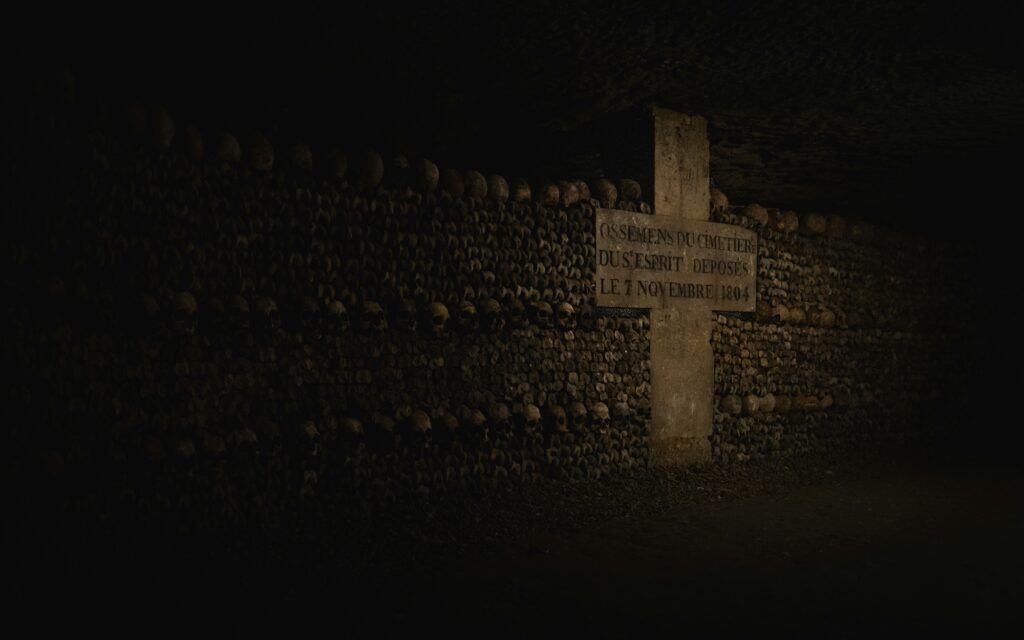
Initially, the bones were piled chaotically. But in 1810, French engineer Louis-Étienne François Héricart de Thury transformed the catacombs forever. His renovation transformed the chaotic remains into a structured underground ossuary — now recognized as the world’s largest burial site.
Skulls were aligned, femurs arranged into walls, and symmetrical rows brought order to what had once seemed impossible to contain. In every alcove, inscriptions marked the cemetery of origin and the year of transfer.
What began as a public health measure became one of the most iconic ossuaries in the world—a place that preserves not just human remains, but the memory of a Paris that solved its problems by burying them.
Visiting the Catacombs Today
Today, the Paris Catacombs are among the city’s most intriguing attractions. But they’re not for everyone.
Visitors descend a narrow spiral staircase into dimly lit tunnels 20 meters underground, where they wind beneath the streets.
Only 2 of the Catacombs’ 320 kilometers are open to the public, but the experience is unforgettable. The air is heavy. The silence, absolute. And the bones — over six million of them — rest in carefully ordered rows.
Down here, in what some call the Avenue of the Dead, lies a sobering reminder: Paris’s history isn’t always elegant. Sometimes, it’s carved in skulls and silence.
A Square and a Fountain That Remember the Lost Cemetery
Today, the site where the Cemetery of the Innocents once stood is now a lively square lined with shops, cafés, and bistros.
At its center stands a monumental 16th-century fountain—the oldest in Paris—commemorating this dark chapter in the city’s history.
Because in a city that thrives on light, there is also a hidden Paris: deep, haunting, and impossible to forget. A Paris of plague and ruin, of desperate measures and grim resolve. But also of memory, dignity, and our enduring respect for the dead.