
Within Christian tradition, it is common to exhume the bones of those who have been buried for a long time. In many cases, these remains are stored in places created specifically for this purpose, reflecting a centuries-old bond between faith, remembrance, and the dead.
These places are known as ossuaries, and they are found in many regions of the world. They can appear inside cemeteries, churches, and even catacombs, such as the famous underground burial chambers in Paris.
However, the most extraordinary ossuary of all is located in Sedlec, within the Czech town of Kutná Hora. What makes it unique is not only the number of bones it contains, but the way they are displayed.
It is highly unusual to find a chapel built almost entirely from human bones, a sight that feels both astonishing and deeply unsettling. This extraordinary place draws thousands of visitors every year, captivated by its eerie beauty.
The town of Kutná Hora, known for its beautifully preserved architecture and picturesque surroundings, has been designated a UNESCO World Heritage Site, making it one of the most important historical destinations in the Czech Republic.
The Sedlec Bone Chapel is the dark and unforgettable centerpiece of the town. It is an essential stop for anyone visiting Kutná Hora, though visitors should be warned: what lies inside is not for the faint of heart.
A Macabre Commission Turned Into Art
During the 14th century, the medieval city of Kutná Hora was home to a vast cemetery that became the final resting place for countless victims of the Black Death.
The plague epidemic devastated the region, claiming thousands of lives. Over time, the bones of the dead were gathered and stored in one of the cemetery’s buildings as burial space ran out.
Later, the Church of All Saints was constructed on this very site, and beneath it, the lower chapel became the place where the accumulated bones were kept.
For centuries, these remains lay piled together with little order or care. While practical, this arrangement offered little dignity to the dead whose bones filled the space.
In 1870, the noble Schwarzenberg family set out to change this. They commissioned a local artist and woodcarver, František Rint, to reorganize the ossuary in a more refined manner.
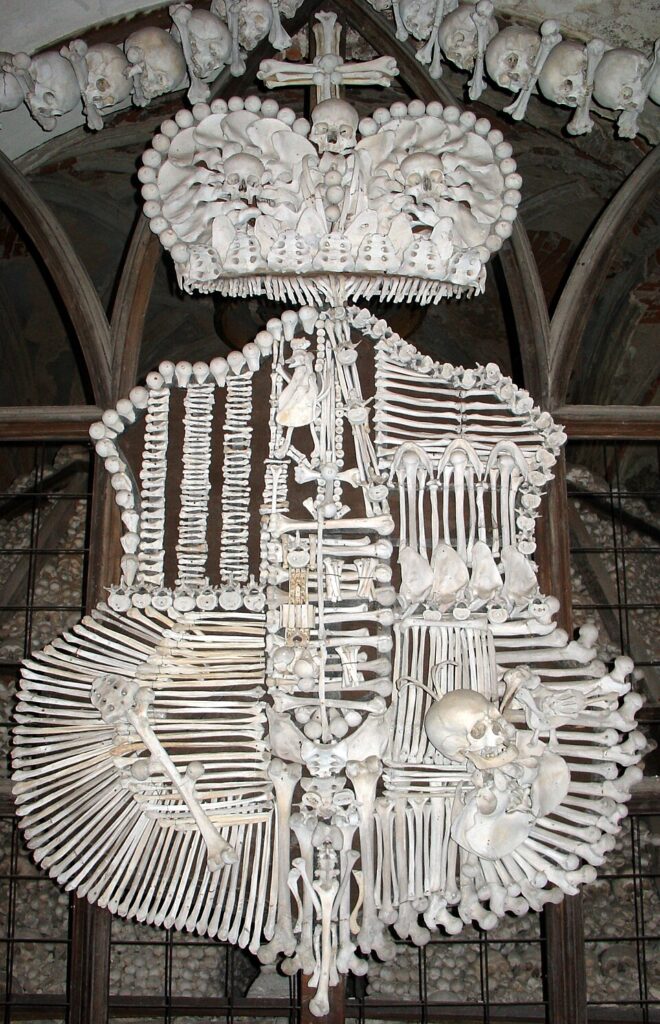
Rint took on the commission — and brought with him a bold and unsettling vision. Instead of simply storing the bones, he chose to use them as the primary material for the chapel’s decoration.
He had been asked to create a more elegant space, and he did exactly that. The chapel was redesigned to feel more open, ordered, and visually harmonious, yet its most striking elements were deeply macabre.
Throughout the chapel, chandeliers, candelabras, coats of arms, and decorative elements were crafted entirely from human bones, meticulously cleaned and preserved.
The result was a space that balanced artistic composition with a haunting reminder of mortality, a place where beauty and death coexist in unsettling harmony.
A Defining Landmark of Dark Tourism
In recent years, dark tourism, also known as thanatourism, has become one of the most intriguing and fastest-growing travel trends worldwide.
Cities such as Paris and Edinburgh have long embraced their darker histories, turning their macabre landmarks and legends into major tourist attractions.
This trend has also reached the Czech Republic, where the Sedlec Ossuary stands as the most iconic and unsettling example of this type of tourism.
Every year, thousands of travelers make the 80-kilometer journey from Prague to Kutná Hora to see this extraordinary and disturbing site for themselves.
The ossuary itself is located inside a beautiful Gothic church, while the town offers other remarkable attractions, such as the Cathedral of Saint Barbara and historic silver-mining sites.
Kutná Hora’s medieval streets and architectural charm create a striking contrast with the eerie atmosphere of the bone chapel, making the visit both visually rich and emotionally intense.
Some visitors find places like this controversial, arguing that turning human remains into a tourist attraction disrespects the dead.
However, František Rint’s intention was the opposite. His goal was to honor the forgotten dead and transform their remains into a lasting work of art.
As one of the most visited and unforgettable sites in Bohemia, the Sedlec Ossuary stands as proof that art, history, and mortality can intersect in powerful and thought-provoking ways.